
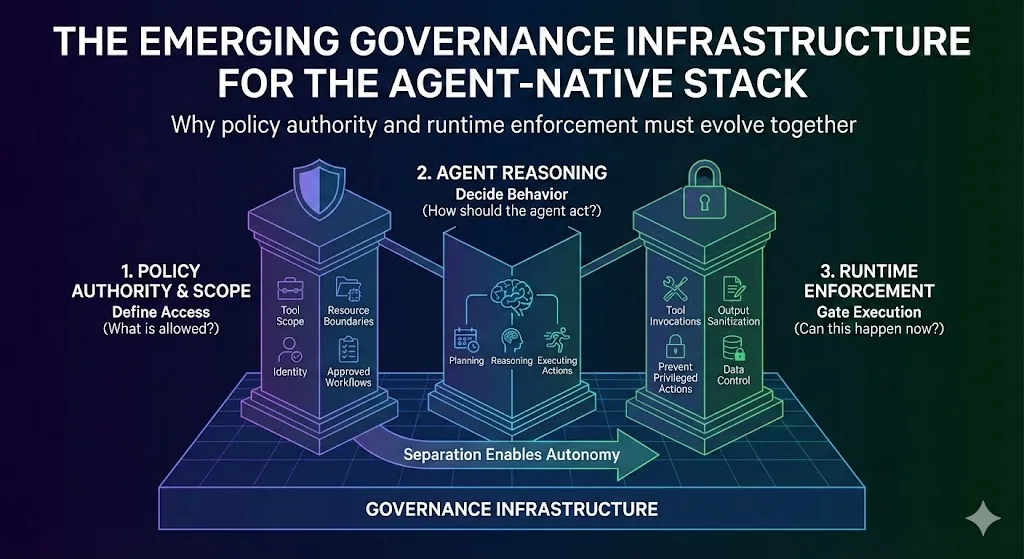
Why policy authority and runtime enforcement must evolve together
AI agents are crossing a threshold. They are no longer just generating text or assisting users. They are planning, reasoning, and executing actions across tools, data, APIs, and infrastructure. As this shift accelerates, a familiar enterprise question reappears in a new form:
Where does governance live when systems act autonomously?
The answer is not “inside the model,” and it’s not “after the fact.” What’s emerging instead is a new governance architecture - one that separates policy authority from runtime enforcement, and treats governance as infrastructure for the agent-native stack.
Why Governance Must Become Infrastructure
For decades, governance has been embedded in applications, workflows, and human review processes. That model worked when software waited for people to click buttons.
Agents don’t wait. They assemble workflows dynamically, chain actions together, and operate at machine speed. Governing them with UI approvals or post-hoc audits is not just ineffective - it is structurally mismatched.
What’s required is not another agent governance product, but governance infrastructure: a foundational layer that defines boundaries clearly and enforces them deterministically.
Pillar 1: Policy Authority Must Be Explicit
Agentic systems need a clear way to define what is allowed in principle.
Policy authority establishes the boundaries within which an agent may operate:
-
which tools it can discover
-
which actions those tools expose
-
which resources and data are in scope
-
under what identity and constraints
This layer does not decide whether an action occurs. It defines scope and authority.
Illustrative examples of policy authority include:
-
Tool and capability scope (read vs write vs administrative actions)
-
Resource and data boundaries (datasets, environments, sensitivity tiers)
-
Identity and execution context (service identity vs human identity)
-
Approved templates and workflows (predefined tasks vs ad-hoc behavior)
-
Cost, quota, and regional constraints
Emerging standards such as the Model Context Protocol (MCP) are beginning to formalize this layer by making authority and scope explicit rather than implicit. In doing so, they give agentic systems a shared language for what is permitted.
Policy authority answers a single question:
What is this agent allowed to access?
Why Policy Authority Alone Is Insufficient
Authorization does not guarantee safe or appropriate behavior.
An agent may be authorized to access a tool and still:
-
act at the wrong time
-
operate with excessive scope
-
expose sensitive data
-
cause unintended side effects
Because agents compose actions dynamically and operate without human pause, context matters. Timing, intent, and blast radius all influence whether an action should occur.
This is where most AI risk lives - in the gap between what is allowed in principle and what actually happens in practice.
Pillar 2: Enforcement Must Be Runtime-Native
Execution happens at runtime.
That is where agents:
-
invoke tools
-
write files
-
call APIs
-
return outputs
-
trigger real-world side effects
This is the layer where intent becomes impact.
Modern agent runtimes increasingly expose execution boundaries where actions can be inspected, gated, or denied in real time. These boundaries are not theoretical - they are the precise moments where an agent’s decisions translate into irreversible outcomes.
If governance does not exist at this layer, it is advisory at best.
Runtime-native enforcement means controls are applied at the moment of execution, not before and not after. Examples include:
-
gating tool invocations before they occur
-
sanitizing or blocking unsafe outputs
-
preventing privileged or destructive actions
-
controlling what data enters or exits the agent’s execution path
The model plays a critical role here - it reasons about intent, evaluates context, and determines what it wants to do. But the runtime is where that intent is reconciled with reality.
At runtime, enforcement becomes:
-
deterministic rather than probabilistic
-
non-bypassable rather than best-effort
-
contextual rather than static
This is what allows agents to operate autonomously without operating unchecked.
Runtime enforcement answers a fundamentally different question than policy authority:
Can this action happen right now?
That distinction is what makes governance real in agent-native systems.
Pillar 3: Separation Enables Autonomy
Safe autonomy depends on separation of concerns.
In agent-native systems, three responsibilities must remain distinct:
-
Policy authority defines what is allowed
-
Agent reasoning determines how to act within those boundaries
-
Runtime enforcement decides what actually happens
Blurring these roles leads to brittle systems - over-constrained agents on one end, ungovernable autonomy on the other.
Separation is not a limitation. It is what allows autonomy to scale.
The Emerging Governance Stack
As agent platforms mature, a consistent architecture is taking shape:
| Layer | Responsibility | Question Answered |
|---|---|---|
| Policy Authority & Scope | Define access | What is allowed? |
| Agent Reasoning | Decide behavior | How should the agent act? |
| Runtime Enforcement | Gate execution | Can this happen now? |
Each layer does one job well. Together, they form the governance infrastructure required for agent-native systems.
Why This Matters Now
Agents are already operating in production environments. They act faster than human review and span more systems than traditional applications.
Governance debt compounds quickly in this world. By the time controls become visible, damage is often already done.
Standards, architectures, and expectations are forming now - not later. The decisions made today will define whether agentic systems scale safely or become unmanageable.
The One Thing to Remember
Policy authority defines the boundaries of autonomy.
Runtime enforcement makes those boundaries real.
Together, they form the emerging governance infrastructure for the agent-native stack.