
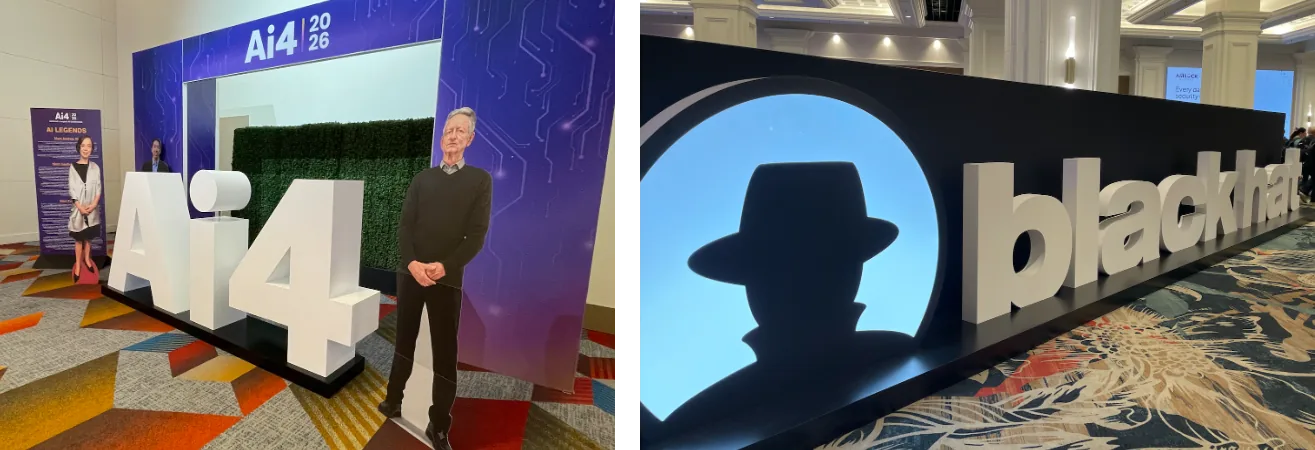
This year, attending both Ai4 and Black Hat in Las Vegas provided a front-row view of the state of enterprise AI. The most insightful hallway conversations with the attendees, presenters, and sponsors at both two events highlighted a powerful, complementary narrative: Ai4 showcased how aggressively enterprises are pushing the boundaries of autonomous innovation and Black Hat underscored the necessity of securing those systems before they hit production. Here are my observations and takeaways from both sides of the enterprise agentic AI adoption.
Two sides of the same AI Coin: Innovation vs. Defense
Ai4 2026: Governing and Accelerating Innovation
- Shift to Agentic Workflows: The conversation moved firmly beyond simple chatbots and Retrieval-Augmented Generation (RAG) toward multi-agent orchestration and autonomous systems acting on behalf of enterprises.
- Value & Adoption Bottlenecks: Enterprises across financial services, healthcare, and retail are eager to scale autonomous AI. However, adoption is not limited by model choices and capabilities, it is bottlenecked by the need for operational control, cost predictability, and risk oversight.
- The “Intelligence, Cost, & Control” Framework: Enterprise mental models for adoption revolve around balancing intelligence (frontier, open weights) quality, costs (deliver outcome), and control (runtime focused). Human bottlenecks and infrastructure constraints are shifting focus toward dynamic, specialized operational roles rather than pure model scaling.
Black Hat USA 2026: Securing and Enabling the Innovation
-
The Agentic Governance Gap: As autonomous agents are deployed into production, security teams are realizing that traditional, static guardrails, periodic risk reviews fail. Many vendors touted AI Detection and Response (AIDR), or AI-powered
, while they acknowledged the need for AI runtime governance controls to ensure agents deliver the desired business outcomes, securely. -
Agents Inventory & Visibility Risks: Security leaders expressed significant concern around ungoverned AI rollouts and the lack of visibility into “Agent Inventory”, that is knowing exactly what agents exist, what tools they access, and what decisions they can execute autonomously.
-
AI Security as an Enabler, Not a Blocker: Rather than slowing down deployments, robust security and runtime governance controls are now recognized as the ultimate prerequisite for unblocking agentic AI rollouts into production.
Key Technical Takeaways
Deterministic Controls Outside the Reasoning Loop
A major point of convergence across both conferences was the architecture of runtime governance and policy controls that are enforceable.
-
Relying on LLMs to self-evaluate policy adherence (LLM-as-a-Judge, Guardian Agents) is inherently non-deterministic and prone to bypasses.
-
There is strong industry consensus, validated by keynotes, enterprise practitioners, and major cloud providers, that deterministic controls must live outside the model’s reasoning loop.
-
Enforcing scoped, deterministic policies and runtime identity checks at the infrastructure/execution level ensures compliance without degrading model reasoning performance.
Why Enterprise AI Governance is Stalling
Conversations with industry advisors and consultants highlighted why many enterprise governance frameworks are currently failing:
- Top-down policy lag: Policies are written for static software, taking months to approve while developers deploy autonomous tools in days.
- Untrained risk boards & sequential reviews: Governance committees lack technical visibility into agent behavior, creating massive review bottlenecks.
- Static controls on dynamic systems: Treating AI like traditional IT assets leaves critical blind spots at runtime when agents execute multi-step model and tool calls.
Strategic Implications & The Path Forward
To bridge the gap between rapid innovation (Ai4) and runtime security (Black Hat), organizations must align around three core principles:
- Runtime Inventory & Identity First: You cannot secure what you cannot see. Establishing continuous discovery, inventory tracking, and identity verification for every active agent is step zero. MCP context authorization is essential for understanding approved agent actions.
- Decouple Policy Decision and Enforcement from Reasoning: Runtime Governance must be enforced outside the LLM reasoning path using deterministic runtime checks.
- Streamline Services & Forward Integration: Unlocking production AI requires close collaboration between security engineering and forward-deployed integration teams to embed runtime controls natively into enterprise workflows.
Conclusion
The key message from Vegas is clear: AI innovation cannot outpace AI security. Runtime governance implemented outside the reasoning loop gives CTOs and AI teams the freedom to innovate rapidly while giving IT and Security teams the deterministic controls they require.