Stop runaway agents before they blow your budget
Per-workflow, real-time token-spend enforcement. Set a flexible rolling budget, configurable per policy — not a monthly cap you discover too late — and LangGuard hard-blocks the workflow that runs away, without taking the rest of the agent down.
Observability ≠ Control
You can watch the cost climb in a dashboard.
That alone doesn’t stop it.
The gap between seeing the spend and stopping it is where your budget lives.
Core Capabilities
Govern AI Spend at the Workflow Level
A control plane for metering, budgeting, and enforcing token spend across every AI agent and workflow — in real time, before the bill arrives.
Per-Workflow Cost Rollups
Meter spend for each agent workflow independently — not just per app or per endpoint. Scope a budget to whatever unit you choose, and see exactly which workflow is burning it.
Real-Time Budget Enforcement
Hard-block a workflow at the interceptor the moment it crosses budget — a live HTTP 4xx, not an email tomorrow. The runaway stops; every other workflow keeps serving.
Stage-Aware Policies
Same budget, different teeth. One policy alerts in development and enforces in production — gated by deployment stage, so you tighten the screws only where it counts.
Cost & Token Visibility
Track USD and tokens per workflow, model, and time window — with an auditable violation record for every block. Chargeback, showback, and post-mortems with the receipts attached.
Seen in Production
When One Workflow Goes Off the Rails
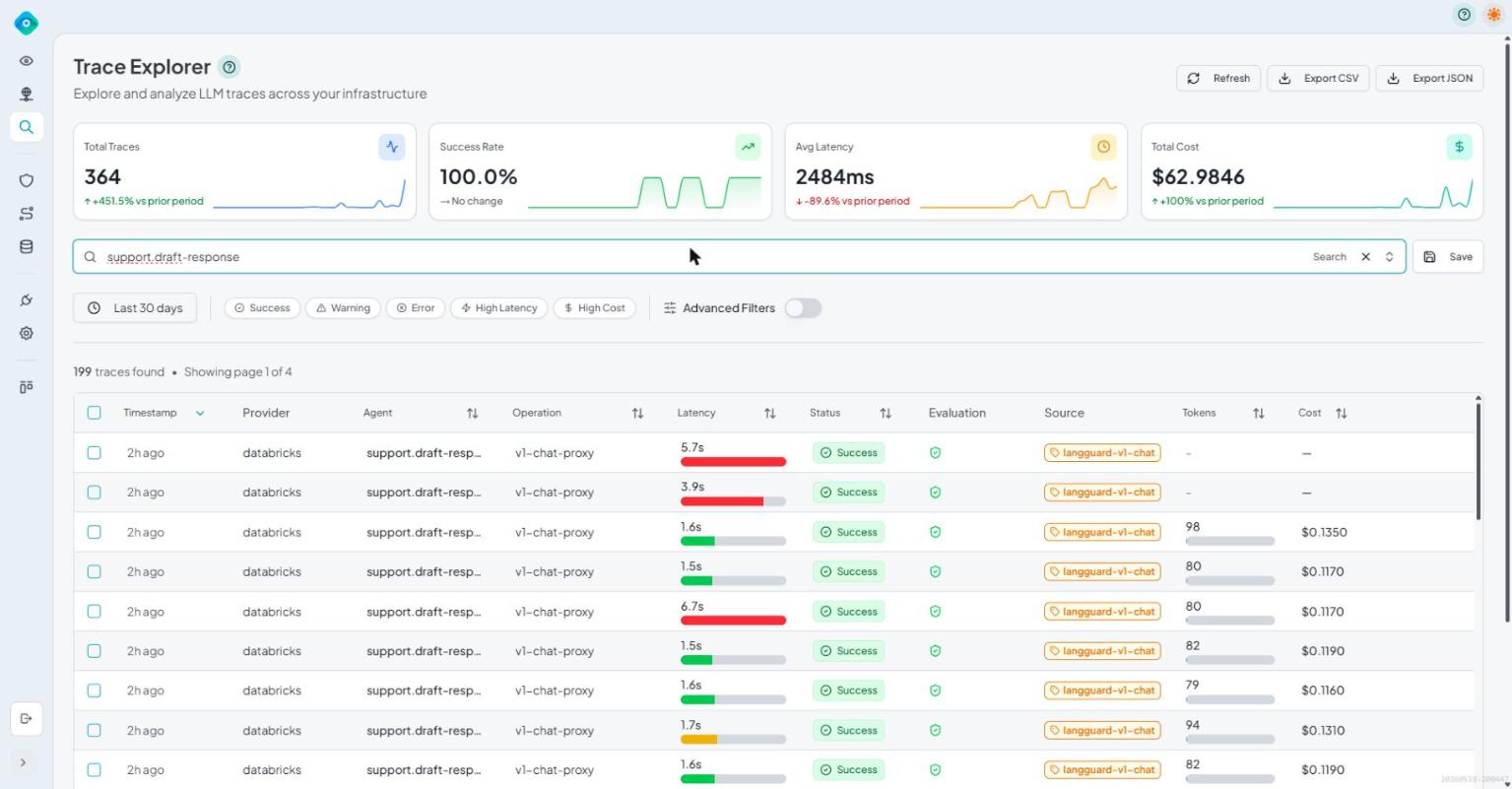
A single sub-workflow gets stuck in a retry storm and doubles the bill in minutes. LangGuard sees it per workflow, in real time — and meters every call against the budget.
The Differentiator
What Native AI Budget Controls Can’t Do
Native AI budget controls track spend at the workspace or account level, monthly, and alert after the fact. LangGuard meters every call in real time — so the budget is scoped to whatever you choose, sub-monthly, and actually enforceable.
| Native AI Budget Controls | LangGuard | |
|---|---|---|
| Smallest targetable unit | Workspace, tag, or per-user | Any unit you choose — down to a single workflow inside one agent |
| Time window | Monthly only | A flexible rolling budget, configurable per policy |
| Enforcement | Alerts only (email) — no blocking | Hard block the moment budget is crossed (or alert-only mode) |
| Detection latency | Up to a 24-hour delay | Real time |
| Units | USD only, list price | USD and tokens |
| Environment-aware | Tags only — no first-class dev/prod | First-class stage — enforce in prod, alert in dev |
| Model coverage | External / provisioned models not tracked | Any model the agent calls — provisioned, external, or third-party |
| Alert ceiling | Max four alerts per budget | Unlimited — every block is a policy-violation event |
Both approaches use the word “budget.” That’s where the resemblance ends.
Use Cases
Where Per-Workflow Budgets Pay Off
How teams put a real ceiling on agent spend — without slowing the agents that behave.
Stop Runaway Agents
A retry storm or a prompt loop can burn a month of budget in minutes. LangGuard caps each workflow and blocks the offender in real time — the rest of the agent keeps serving customers.
Chargeback & Showback by Workflow
Attribute every dollar and token to a specific workflow, team, or stage. Bill internal teams accurately, spot waste before it compounds, and give finance the per-workflow receipts.
Protect Margins on AI Features
When you ship AI features at a fixed price, one abusive session can erase the margin. Per-workflow budgets keep unit economics predictable — the ceiling holds even when usage spikes.