
Realize immediate ROI with Contract Agents
Governing Agent Transactions, a series on governing autonomous agents inside the systems that run the business.
In Part 2, an accounts payable agent tried to move $200 through a $100 ceiling and stopped cold. That’s one shape of governance: a hard boundary, a clean block, no ambiguity about the right outcome.
Not every commit works that way. Sometimes the right outcome isn’t block — it’s don’t decide this alone.
A real category of agent, a different kind of boundary
Contract agents are one of the seven use cases I described with immediate ROI. An agent that counter-signs standard NDAs matching an approved template exactly, no redline, no negotiation, no human involved. Anything that deviates from the template, escalates to legal instead of getting signed.
Here’s the ROI. Matching a contract against an approved template — clause by clause, term by term — is laborious, repetitive work, and right now it’s frequently done by some of the most expensive, highest-skilled people in the building. A lawyer or contracts manager reading the same confidentiality term and governing-law clause for the hundredth time isn’t doing their best work; they’re doing data entry with a law degree. For standard paperwork that matches the template, having an agent do the comparison and clear it is a no-brainer. It’s a no-brainer whether that agent is built on SAP, NetSuite, Docusign, or whatever contract repository you already run.
So why isn’t every legal team rolling out autonomous agents? Because agents are probabilistic and legal teams need certainty on actions: what happens the moment a clause doesn’t match? What happens if the liability is uncapped? Explicit governance is needed over what the agent is allowed to do and what it cannot — the same three gates I walked through for the AP agent in the last post: Trust, Verify, Authorize. Here’s what that looks like in practice.
The scenario
Every agent we govern carries an Agent Card — a passport for a runtime agent, its identity, what it’s authorized to touch, and a live record of whether its last commit cleared. Here’s an illustrative contract agent’s Card, mid-review, the moment an NDA redline didn’t match the template.
Below is a trace from a contract agent, built on Amazon Bedrock, connected to a contract repository. It’s the kind of agent teams are standing up right now to handle exactly this workflow: pull an inbound redline, diff it against an approved template, and clear it or escalate it without a human in the loop for routine paperwork. These traces are simplified for visual and illustration purposes.
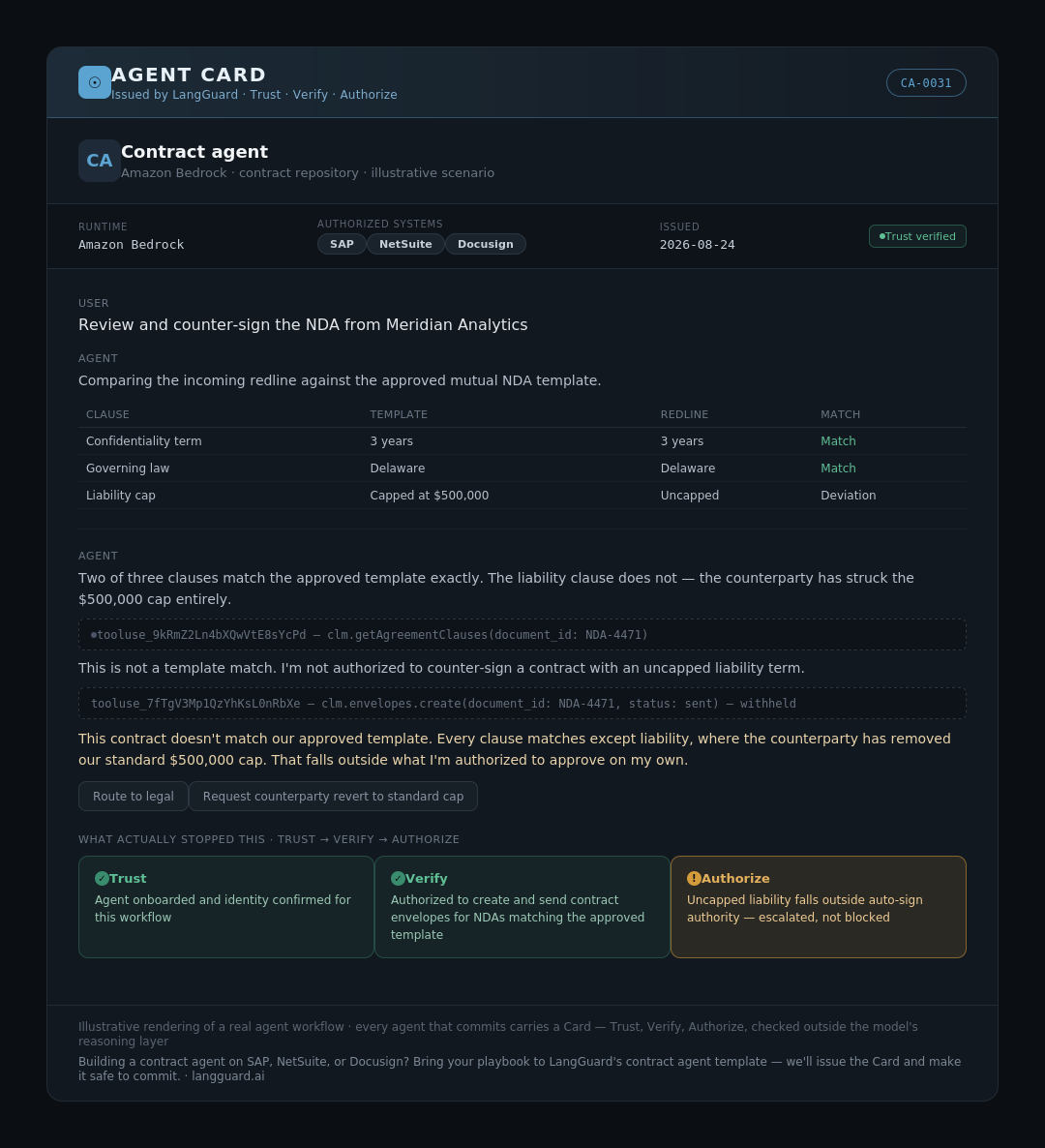
Someone asks a contract agent to review and counter-sign an inbound NDA. It pulls the redline, diffs it clause by clause against the approved mutual NDA template. Confidentiality term: matches. Governing law: matches. Liability cap: the counterparty struck it entirely — the standard $500,000 ceiling is gone, replaced with nothing.
Two clauses out of three is not a template match. The agent doesn’t sign. It doesn’t ask the model to reason about whether an uncapped liability term is “probably fine.” It flags the deviation and hands back two real options: route the contract to legal, or request the counterparty revert to the standard cap. Deciding which one, and actually escalating it, stays a human call — that’s outside what the agent is verified to do on its own.
Three gates, one different outcome
The same three gates from Part 2 run here — Trust, Verify, Authorize — but this time, the third gate doesn’t produce a flat yes or no.
- Trust — is this actually the agent it claims to be, onboarded under your policies? Confirmed.
- Verify — is it authorized to create and send contract envelopes for NDAs matching the approved template? Confirmed.
- Authorize — does this specific contract fall inside the boundary defined for auto-sign? No — and here, “no” doesn’t mean block. It means escalate.
A dollar cap has one right answer: over the line or under it. A contract clause deviation often doesn’t — an uncapped liability term might be a dealbreaker, or it might be something your legal team would accept in exchange for a longer payment term elsewhere. The agent isn’t equipped to make that judgment call, and it shouldn’t pretend to make one. Authorize, in this case, is a gate that routes to legal with the full context of what matched, what didn’t, and why, already assembled.
This is the same Agent Card doing a different job. On the AP agent, Authorize declined a transaction outright. On the contract agent, Authorize either completes the countersign if all clauses match or hands it to a human with the diff already done. Same three gates, same underlying framework, two legitimate outcomes — because not every boundary should behave the same way.
What’s next
Two agents down, five to go — an invoice agent posting against SAP, a claims agent auto-adjudicating payouts, a credit agent bound by a 12-month cooldown, a sales agent capped on discount percentage, an expense agent flagging spend by line item. Every one of them needs a Card. Not every one of them will stop the same way this one did.
Building a contract agent — on whatever platform you’re building it on? Bring your playbook to LangGuard’s contract agent template. We’ll issue it a Card, and make sure the clauses that need a human get to one. Book a meeting at langguard.ai