
Decoding Agent Security: An Implementation Guide for Deploying Autonomous Agents Safely
Anchored in OpenAI’s “Agent Security in the Enterprise” white paper (August 2026)
Why This Paper Exists
The era of autonomous agents is here. For CISOs, security leaders, and technical decision-makers who are deeply practiced in human-centric security paradigms — traditional detection and response, this is a transition moment into something newer and unsettling. Agents don’t fit traditional security practices: a person exercising judgment inside a role, or a piece of software executing fixed rules. An agent does neither — it interprets, decides, and acts on its own, and is completely non deterministic.
How do you secure and govern autonomous actors that take actions and operate inside the enterprise the way humans do.
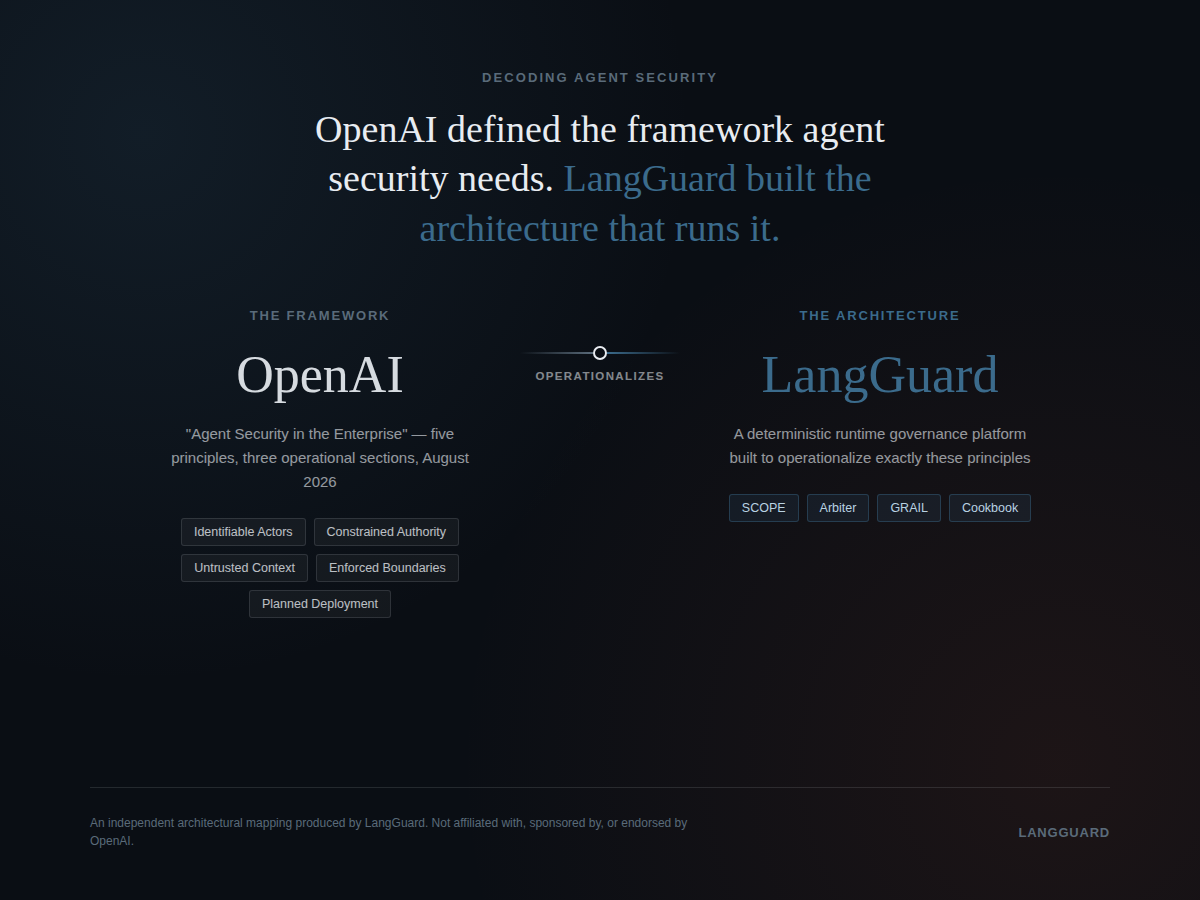
CISOs need an actionable mental model for securing autonomous agents. OpenAI’s security paper provides exactly that: a practical guide for operationalizing agent security, written for CISOs, security leaders, and the technical decision-makers responsible for bringing agents into the enterprise. The OpenAI guide aligns closely with the architecture LangGuard has built toward.
Given that alignment, LangGuard has mapped OpenAI’s security guide and CISO deployment checklist end to end. The paper is structured around five core principles across three operational sections; this mapping traces each section down to the technology and operational controls needed for assessing risk, setting security expectations, and guiding teams as deployments mature.
The Five Principles: A New Mental Model for CISOs and Security leaders
Securing autonomous agents is a different problem from securing human access, and OpenAI’s five principles define the mental model.
1. Agents as identifiable actors — the user or organization responsible for an agent, the runtime carrying it out, and the task it’s performing are three distinct things that need to stay distinguishable from one another.
2. Constrain authority to the task at hand — an agent’s access, capabilities, and execution environment should be limited to what its task requires, with stronger controls applied as potential impact grows.
3. Assume context is untrusted — retrieved content and tool responses can shape an agent’s behavior as directly as an instruction can, so that path has to be part of the security model, and untrusted context should never be able to authorize a consequential action on its own.
4. Enforce boundaries and observe actions — authorization and policy controls need to keep working even when an agent is mistaken or misaligned, and every action needs to be auditable.
5. Deploy with a plan — organizations need to understand the security posture of an agent before deploying it, including where it’s hosted and what it can reach.
Once these five ideas are in place, OpenAI’s own three operational sections — Understanding Agentic Risk, Boundaries for Agent Action, and Securing Agent Operations lay the foundation for the design and deployment of agentic security controls.
Matrix 1: Five Principles × Three Sections
This section maps the five principles into the the three operational sections.
| Principle | Understanding Agentic Risk | Boundaries for Agent Action | Securing Agent Operations |
|---|---|---|---|
| 01 Agents as identifiable actors |
Three actors: Employee, conventional software, and agent | Reach and blast radius | Shared responsibility and deployment models |
| 02 Constrain authority to the task |
Develop threat model agent deployments | Map the Action Boundary and Consequential Actions for each Agent Actor: Employee, conventional software, Agent, Tool | Secure the agent runtime with Runtime controls |
| 03 Assume context is untrusted |
Track and annotate all pathways in which context flows between systems, tools, and harnesses; prevent untrusted context from authorizing consequential actions | Ensure every Action and Tool Action has policy enforcement independent of context | Implement Agent Incident Response for unauthorized actions |
| 04 Enforce boundaries, observe actions |
Develop a risk map for all consequential Tools and Actions | Enforce deterministic policy controls for each 3-tuple: Agent Actor, Tool, Action | Build a reinforcement loop for detecting Agent failure modes and remediating runtime policy gaps |
| 05 Deploy with a plan |
Implement threat models to assess Agent Reach; implement independent adversarial testing | Continually stress-test Agent Tool and Action exposure against observed telemetry | Implement Agent Entity Behavioral Analytics (AEBA) for Agent Incident Response and SOC teams |
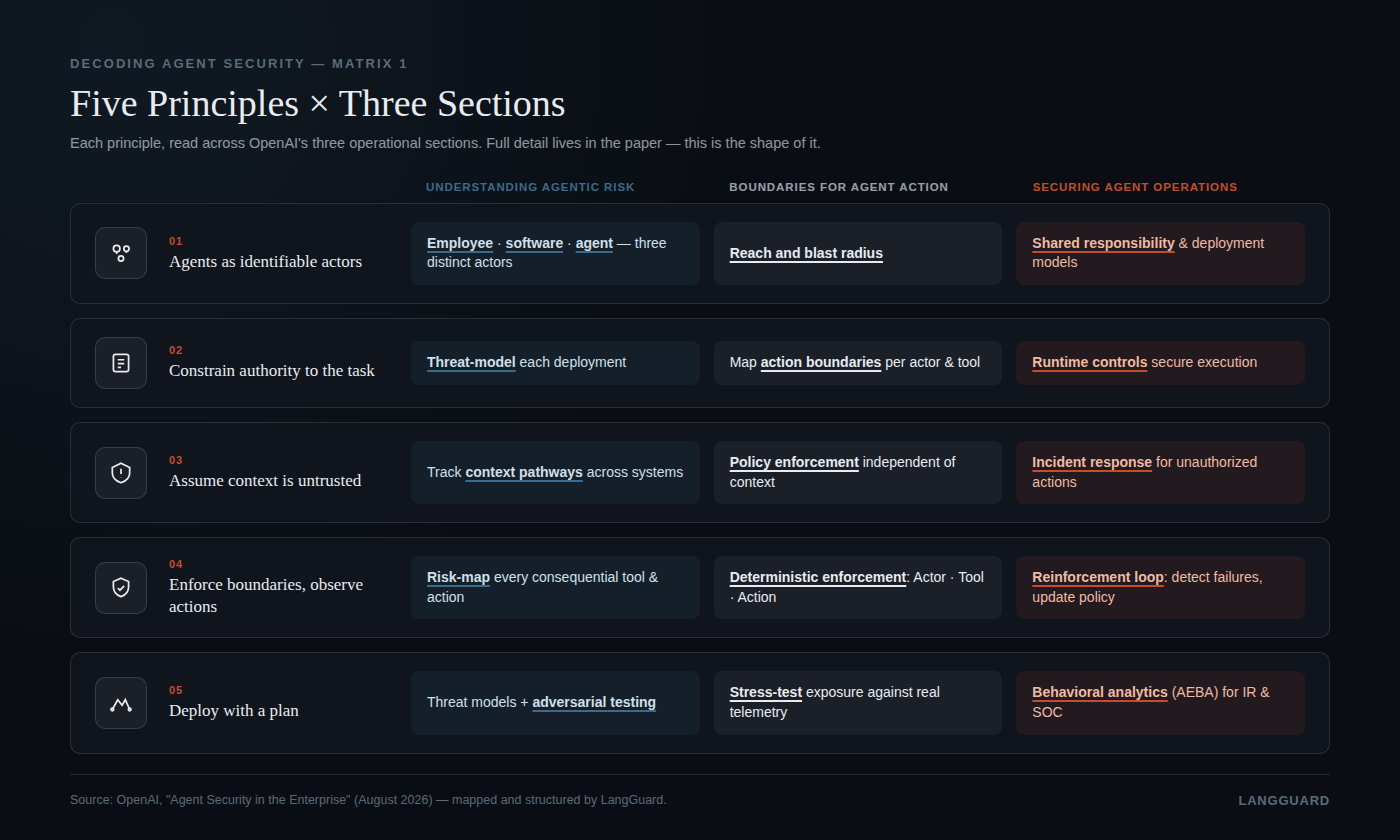
Read down any column and you get what a section is actually responsible for. Read across any row and you get what a principle actually demands, end to end, from first deployment through ongoing operations.
Matrix 2: Sections → Technology Categories
This section maps sections to eight technology categories.
Understanding Agentic Risk — Actor & Reach Classification — Threat Modeling & Adversarial Validation
Boundaries for Agent Action — Agent Identity & Action-Boundary Mapping — Deterministic Policy Enforcement — Continuous Validation & Stress-Testing
Securing Agent Operations — Deployment Posture & Runtime Controls — Observability, Detection & Response — Agent Entity Behavioral Analytics (AEBA)
These eight categories are the practical inventory a CISO needs to either build or buy. They’re vendor-neutral by construction — every one of them is a direct cluster of language already present in OpenAI’s own paper.
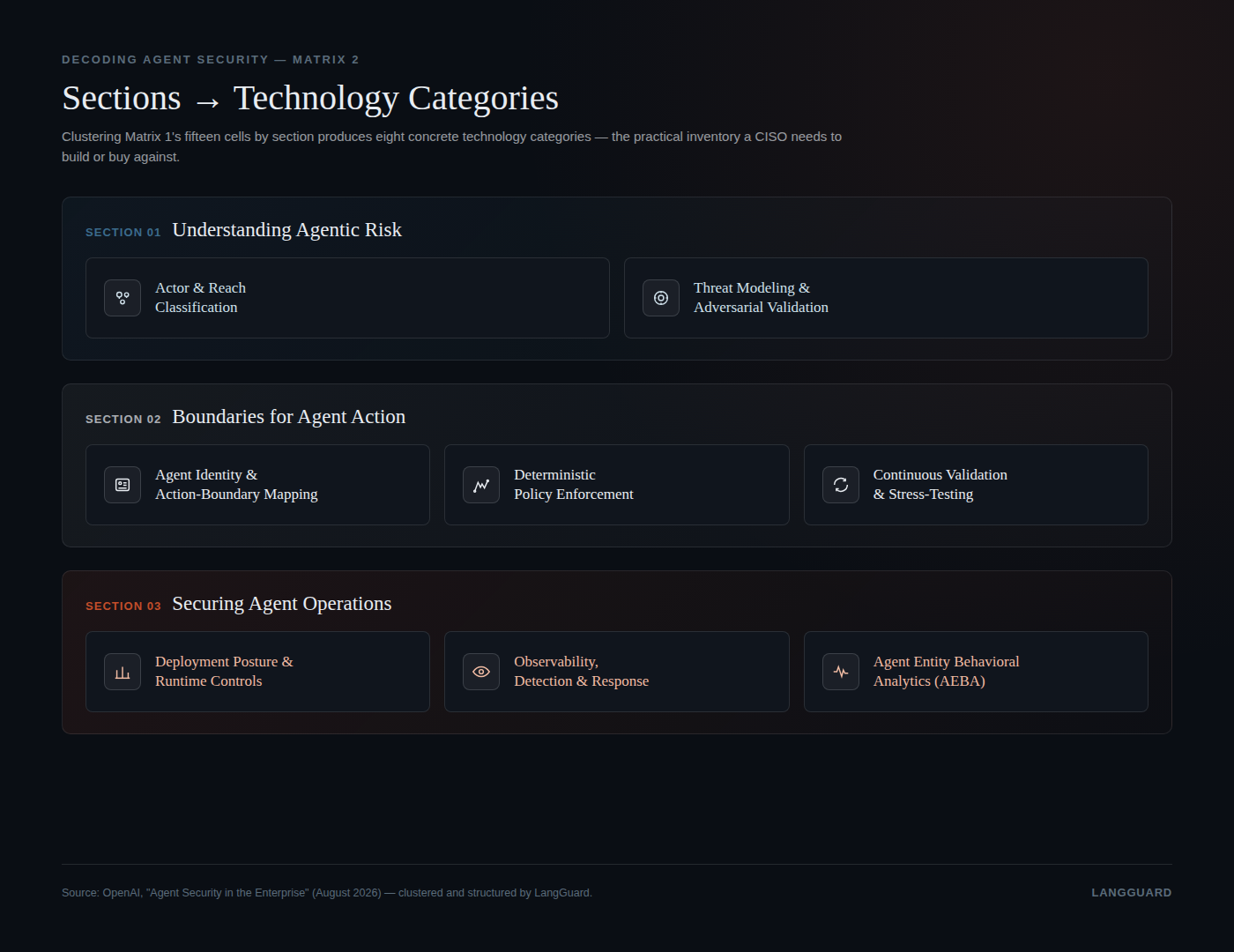
These eight categories are the practical inventory a CISO needs to either build or buy. They’re vendor-neutral by construction — every one of them is a direct cluster of language already present in OpenAI’s own paper.
Executing the CISO Checklist
The eight technology categories above are vendor-neutral. Here’s where LangGuard’s platform maps against each one.
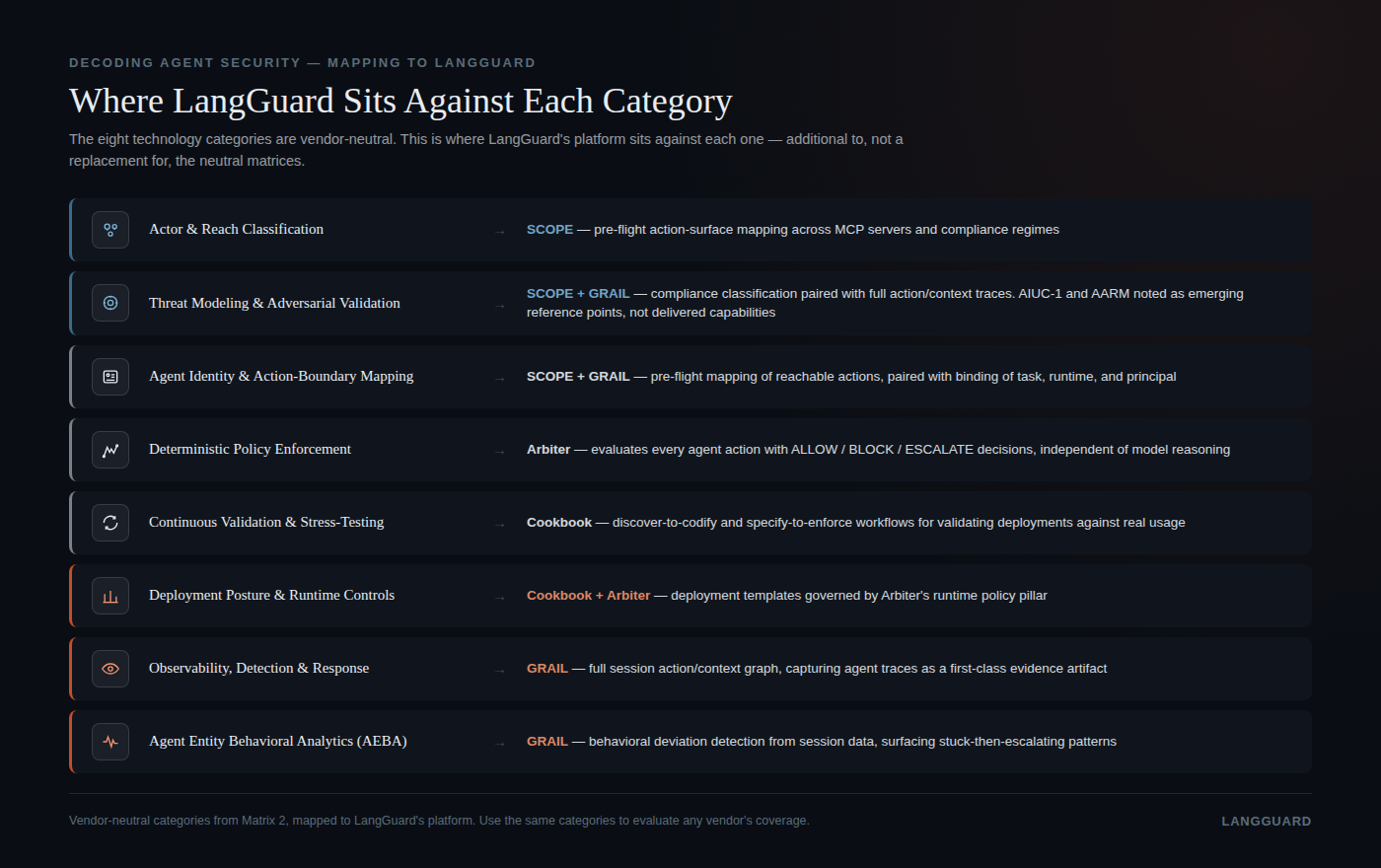
This mapping is additional to, not a replacement for, the neutral matrices above. A security team can use Matrix 1 and Matrix 2 to evaluate any vendor’s coverage — LangGuard included — against the same eight categories.
Close
Moving from a human-centric security model to one built for autonomous actors is a different paradigm. OpenAI’s checklist is a great practical framework for building out this agent security strategy. The five principles are the mental model that makes that checklist make sense, and the eight technology categories mapped above are what actually staffs or builds against it. Wherever a CISO chooses to start — with the principles, with a specific deployment, or with this architecture map — the goal is the same: turn an unfamiliar and scary problem into one with a concrete, actionable path forward.
OpenAI’s full paper, “Agent Security in the Enterprise” (August 2026), is available at openai.com/business/learn/agent-security-enterprise (registration required).