
Claude for Financial Services: From Agent Template to Production
Part 1: The Five Layers Nobody Talks About
May 5th. New York City. Andrew Sorkin, Jamie Dimon, and Dario Amodei on the same stage discussing how AI lives in the world of finance.
FactSet dropped 8%. Morningstar fell 3%.
Wall Street heard “ready-to-run agents.” Nobody asked what it takes to safely build and operate them.
What Anthropic launched
Anthropic launched Claude for Financial Services — five agent templates for the most time-consuming work in financial services: GL reconciliation, KYC screening, month-end close, statement audit, and valuation review.
The event was invite-only. The audience was the who’s who of financial services. The message was clear: AI agents are ready for finance.
Anthropic called these templates starting points.
They are right. And that is the problem.
What the templates actually ship
Each template packages three things:
- Skills — domain knowledge telling Claude how to think about GL reconciliation, how to approach a KYC file, how to run a month-end close checklist
- Scaffolding — a system prompt and agent structure
- Tool contracts — abstract namespaces like
mcp__internal-gl__*that say “I expect a GL server to exist here”
That reasoning is genuinely valuable. It encodes months of prompt engineering for workflows that take years to understand deeply.
But Anthropic’s own README is explicit: “does not post to a ledger… every output is staged for human sign-off.”
Staged by whom. Enforced how. That is what the templates do not address.
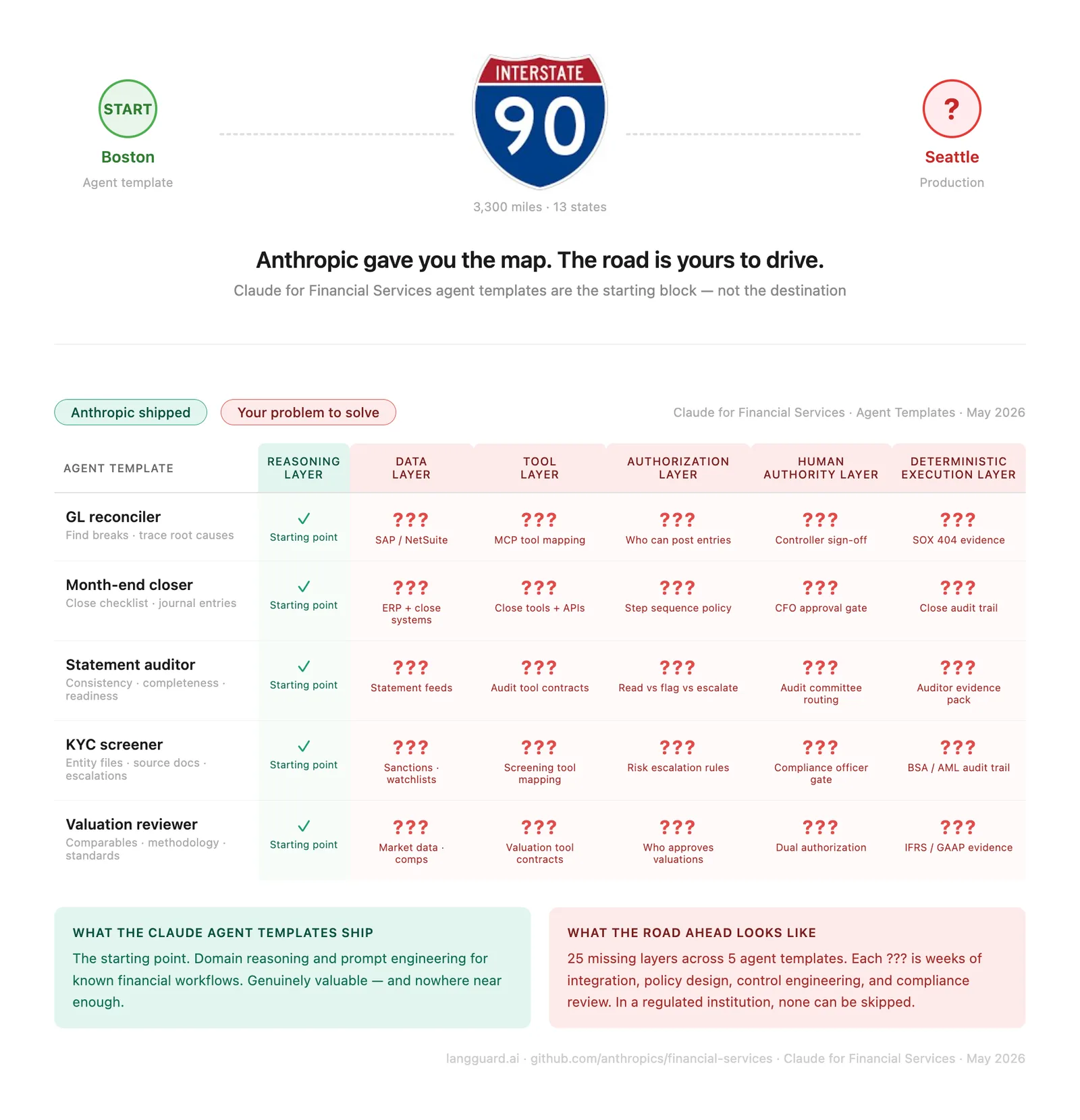
The map
Insert ??? table visual here
One green column. Twenty-five red question marks.
That is the gap between a Claude agent template and a production-ready financial agent in a regulated institution.
Safe production in a regulated institution demands five layers every institution must have:
L1 — Data layer
There is no live connection to SAP, NetSuite, Oracle, or any system of record. The templates define tool contracts and expect the enterprise to wire real MCP servers to them.
L2 — Tool layer
Every tool the agent invokes needs to be classified before it touches production. What is the risk level? What compliance regimes does it trigger — SOX, GDPR, BSA/AML, SOC 2? What action pairs create Segregation of Duties conflicts?
L3 — Authorization layer
Who and what is permitted to act in this workflow? The GL agent that identifies breaks cannot approve its own correcting entries. That is SoD — and it applies to agents exactly as it applies to humans. There is no policy engine in the template. No enforcement mechanism.
L4 — Human authority layer
Anthropic mandates human sign-off. The template provides no mechanism to enforce it. Staging without enforcement is advisory, not operational. Production requires explicit human approval gates — enforced, not suggested — for every irreversible, destructive, or high-risk action.
L5 — Deterministic execution layer
The last mile. No probabilistic action should pass this gate. Every action needs an authorization basis — who sanctioned it, under which policy, what the evidence is. That evidence is what your SOX auditor will ask for. It needs to exist before the action executes, not after.
The road ahead
Taking any one of these agent templates from starting block to production in a regulated financial institution is not a straight road.
It is I-90 in January.
Boston to Seattle. 3,300 miles. 13 states. Each layer is a state you have to drive through.
This is not a criticism of Anthropic. The reasoning layer is real and valuable. A blueprint is genuinely useful. But a blueprint is not a building.
Who has to build this
The Accentures, KPMGs, EYs, PwCs, Deloittes, and McKinseys in the room on May 5th already know this. For them it is a new engagement pipeline. Every financial institution deploying these templates needs an implementation partner who can deliver all five layers.
For enterprises without that support — the path to production runs through a Big 6 engagement or a team of Forward Deployment Engineers building the harness from scratch.
Either way, it is a long road.
What LangGuard is building
LangGuard is building the safe production blueprint for each of these five agent templates.
We are not waiting for someone else to figure this out. We are mapping every mile — layer by layer, template by template — and publishing it as an open resource for enterprises, FDEs, and implementation partners.
Starting with the GL Reconciler.
👉 Read the GL Reconciler production blueprint: github.com/LangGuard-AI/financial-services
If you are an enterprise evaluating these templates, an FDE building deployments, or a consulting practice standing up Claude for Financial Services — get in the car.
Follow LangGuard. Engage with us. Help shape the recipe.
The road is long. Let’s drive it together.
Up next in this series
Part 2: GL Reconciler — The Production Blueprint
LangGuard · Agentic Workflow Governance · langguard.ai
This post reflects LangGuard’s analysis of the Claude for Financial Services agent templates. It is not legal or compliance advice. Consult your internal audit and legal teams before deploying AI agents in regulated workflows.