
EU AI Act Compliance Is Coming: 5 Steps to Get Your AI Agents Audit-Ready Before 2027

The EU AI Act is no longer a future compliance project.
Transparency duties took effect on 2 August 2026. High-risk obligations for many systems used in employment, education, critical infrastructure, essential services, migration, and other sensitive areas apply from 2 December 2027. That gives enterprise teams a defined operating window. You need to meet current transparency requirements, identify high-risk use cases, and build the evidence and enforcement mechanisms that regulators, auditors, and internal risk owners will expect.
The challenge is not only documentation. AI agents take actions. They access data, call tools, modify records, create transactions, and trigger workflows. Your compliance controls must govern those actions at the moment they occur.
A policy document cannot stop an unauthorized tool call.
A dashboard cannot approve a high-risk operation.
A log line cannot prove who authorized an action.
You need enterprise AI compliance that operates across the full agent lifecycle: map, authorize, and record.
What changed on 2 August 2026?
The European Commission states that Article 50 transparency obligations now apply to certain AI systems. The requirements cover both providers and deployers, although the specific responsibility depends on how your organization supplies or uses the system.
The rules include:
- Informing people when they are interacting with an AI system, including a chatbot, AI agent, or avatar.
- Making certain AI-generated or manipulated content identifiable through machine-readable markings.
- Clearly labelling deepfakes and certain AI-generated public-interest text.
- Informing people when emotion recognition or biometric categorization systems are used.
The European Commission’s transparency guidance explains the scope and implementation of these obligations.
The distinction matters. Transparency is not the same as authorization.
Telling a user that an agent is non-human does not determine whether that agent may access a personnel record, approve an invoice, or change a customer account. Disclosure informs the person. Runtime authorization controls the action.
You need both.
What changes on 2 December 2027?
The EU AI Act uses a risk-based framework. The Commission’s AI Act overview identifies high-risk use cases involving areas such as:
- Employment and worker management.
- Education and vocational training.
- Critical infrastructure.
- Access to essential private and public services.
- Biometrics and certain biometric categorization systems.
- Migration, asylum, and border control.
- Administration of justice and democratic processes.
From 2 December 2027, relevant high-risk systems face strict obligations covering risk management, data governance, technical documentation, logging, human oversight, accuracy, robustness, cybersecurity, and post-market monitoring.
Not every enterprise agent is automatically high-risk. But your classification cannot rely on the model name or the agent’s marketing description. It must reflect the agent’s purpose, users, data, decisions, connected tools, and operational impact.
That is why audit readiness starts with the action surface.
The 5 steps to EU AI Act audit readiness
1. Inventory every AI agent and connected operation
You cannot govern what you cannot identify.
Most enterprises do not have a complete, current inventory of their AI agents. Agents appear in customer service, finance, HR, development, IT operations, procurement, and internal productivity workflows. They run across multiple models, frameworks, gateways, and Model Context Protocol (MCP) servers.
The first step is to map:
- Every production and pilot agent.
- Every model, gateway, runtime, and agent framework.
- Every connected MCP server and tool.
- Every operation exposed by those tools.
- Every system of record the agent can reach.
- Every person, team, or workflow the agent acts for.
- Every data class the agent can read, transform, or transmit.
This is more precise than recording that an agent has access to “Salesforce” or “the finance system.” A connection is not an authorization boundary.
An agent connected to an accounts-payable system may be able to:
- Read an invoice.
- Create a payment request.
- Approve a payment.
- Modify vendor banking details.
Those are four different operations with four different risk profiles.
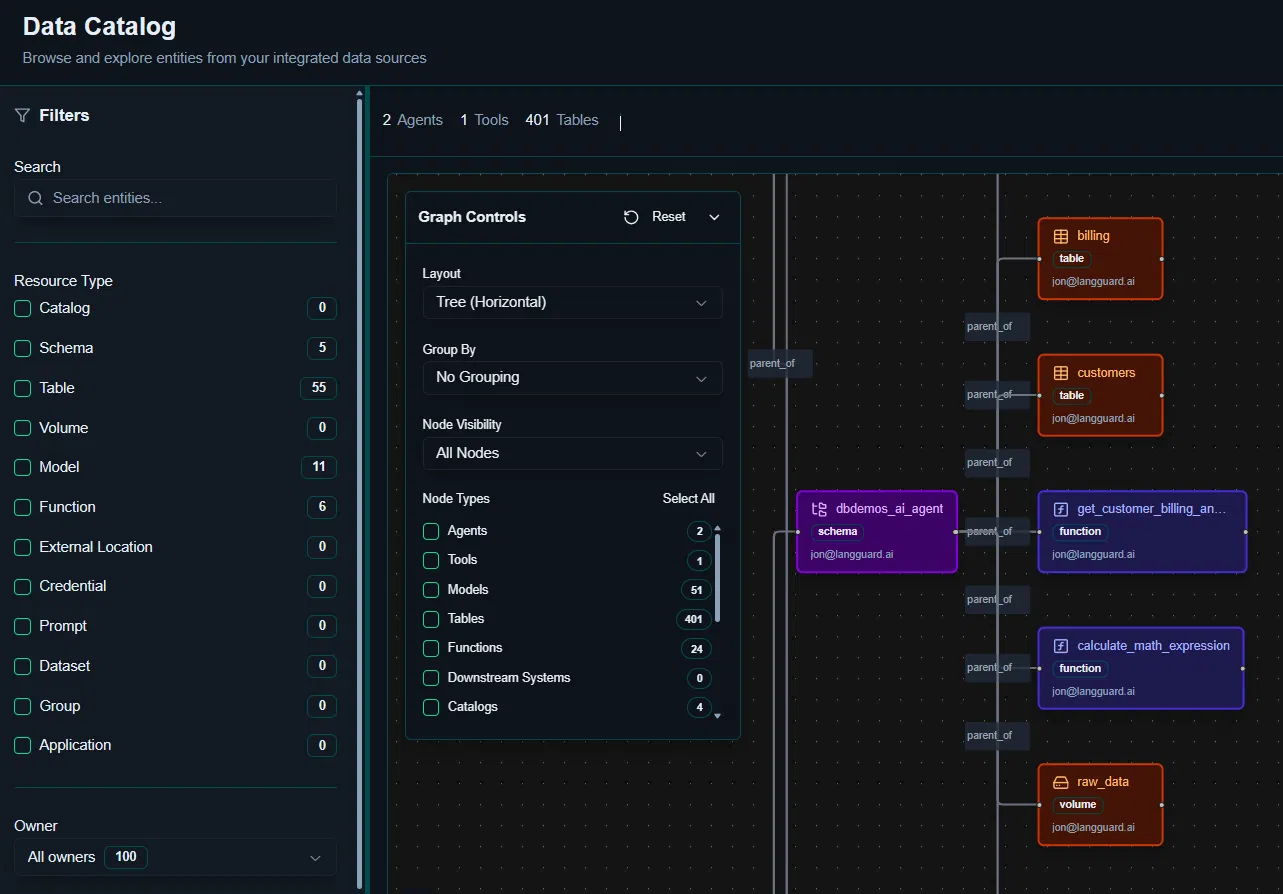
LangGuard SCOPE-MCP maps and catalogs the complete action surface. It identifies the tools and operations an agent can reach, then classifies those capabilities against Segregation of Duties (SoD) rules and applicable control frameworks.
The output is a written scope, not an assumption.

2. Classify your role, use case, and current transparency duties
The EU AI Act distinguishes between providers and deployers. Your obligations depend partly on whether you place an AI system on the market or use it under your organization’s authority.
Your classification process should answer three questions:
What does the agent do?
Does it interact directly with individuals? Does it generate public-facing content? Does it influence employment, access to services, education, financial decisions, or other sensitive outcomes?
Who is affected?
Identify employees, customers, applicants, patients, citizens, suppliers, and other individuals who may interact with or be affected by the system.
What must the person be told?
For applicable Article 50 use cases, confirm that:
- The user knows they are interacting with AI at or before the first interaction.
- AI-generated or manipulated content receives the required labelling.
- Deepfakes are clearly disclosed.
- Applicable emotion recognition or biometric categorization use is disclosed.
- Public-interest text generated without human editorial review is identified appropriately.
Do not treat this as a one-time legal review. Agent prompts, tools, workflows, and user interfaces change. A new tool can alter the agent’s risk classification without changing the model.
This is where design-time governance provides value. It lets your platform team review the action surface before deployment, while maintaining a record of why the system received its classification.
Classification must follow capability and purpose, not branding.
3. Convert broad permissions into operation-level scope
Traditional access controls often answer a narrow question: can this identity connect to this system?
That question is insufficient for agentic workflows.
The more important question is:
Can this agent perform this operation, with these parameters, for this person, against this system, in this context?
Connection-level access grants reach. Operation-level authorization defines scope.
Consider an agent that supports procurement. It may need to read purchase orders and draft vendor communications. It may not need to approve a purchase order, change payment terms, or update banking details.
Your policy should define:
- Which tools the agent may use.
- Which operations each tool may expose.
- Which data the agent may access.
- Which actions require a human approver.
- Which SoD conflicts block execution.
- Which value, volume, or blast-radius thresholds apply.
- Which identity the agent acts for.
- Which purpose permits the use of the data.
This is least privilege applied to agents. It is narrower than inheriting every permission held by the employee who configured the workflow.
For example, an agent that creates a purchase order should not automatically approve that same purchase order. The system must evaluate the separation at the operation level and identify the human authority required for the next step.
SCOPE-MCP establishes the design-time boundary. It also helps platform and GRC teams connect the agent’s capabilities to regulatory and internal-control requirements.
A broad permission is not a compliant scope.
4. Enforce authorization before the tool call executes
This is the point where many governance programs fail.
Monitoring systems detect what happened. Security tools raise alerts. Application logs record requests. These controls remain useful, but they operate after or around the event.
Runtime governance operates at a different moment.
The sequence should be:
- The agent receives instructions and reasons about the task.
- The agent proposes a tool call or business action.
- The runtime policy engine evaluates the proposed action.
- The system returns ALLOW, BLOCK, or ESCALATE.
- Only an allowed action executes.
- The decision is recorded as evidence.
LangGuard Arbiter evaluates every agent action before the tool call executes. It checks the agent’s identity, mapped scope, requested operation, parameters, applicable policy, SoD conditions, and approval requirements.
Safe actions proceed automatically. Exceptional actions receive targeted controls.
That distinction addresses the concern that governance will slow down agent velocity. You do not need a human to approve every read operation or routine workflow step. You need automatic authorization for normal actions and human approval for actions that cross a defined risk boundary.
An action that exceeds a value threshold can be held for a named approver. An action that violates SoD can be blocked. An action involving a regulated system can be escalated. The workflow continues at machine speed until policy requires a person.
Not after-the-fact alerting. Before-execution enforcement.

5. Create replay-ready evidence, not scattered logs
High-risk governance requires records. Internal audit requires traceability. Incident response requires reconstruction. Regulators and risk owners need to know what happened, why it happened, and who was responsible.
A collection of application logs rarely answers those questions by itself.
Your evidence should connect:
- The agent that attempted the action.
- The person, team, or workflow it acted for.
- The tool and operation requested.
- The parameters and target system.
- The data or context relevant to the decision.
- The policy evaluated.
- The decision returned.
- The timestamp of the decision.
- The named approver, where escalation occurred.
- The approval or denial and its timestamp.
- The resulting execution status.
LangGuard’s Audit Ledger records the authorization decision as it happens. It links the action to the agent, identity, policy, scope, approval, and outcome in a tamper-evident, replay-ready record.
That provides a chain of custody for the action.
An auditor can ask:
- Who authorized this operation?
- Which policy applied?
- What was the agent capable of doing?
- Was a human actually involved?
- Did the action execute only after approval?
- Can the decision be reproduced?
Your evidence should answer directly.
Not a reconstruction. Evidence.
How to prepare without creating a governance bottleneck
An effective implementation does not begin with every agent in the enterprise. Start with one priority workflow that has meaningful business impact and a defined owner.
A bounded deployment can run in three stages:
| Stage | Control objective | Practical output |
|---|---|---|
| Weeks 1–2: Map | Discover agents, tools, operations, identities, and systems of record. | Complete action-surface inventory and initial risk classification. |
| Weeks 3–4: Authorize | Define scope, SoD rules, trusted paths, thresholds, and approval routes. | Versioned policies with allow, block, and escalate outcomes. |
| Weeks 5–6: Record | Enforce decisions in production and capture evidence continuously. | Runtime controls, approval workflows, monitoring, and Audit Ledger records. |
This approach keeps implementation measurable. Your team does not need to pause its AI program while it designs a theoretical governance model. It needs to place a control layer above existing infrastructure and connect it to the systems where agents act.
LangGuard supports this lifecycle through runtime AI governance infrastructure, with SCOPE-MCP for design-time discovery and classification, Arbiter for deterministic runtime authorization, and the Audit Ledger for evidence.
The result is enterprise AI compliance that supports velocity rather than replacing it with manual review.
The deadline is not the starting point
The high-risk deadline is 2 December 2027. It is not the date to begin discovering your agents, defining ownership, or deciding how approvals work.
Those controls require integration, testing, policy ownership, and operational adoption.
Start with five questions:
- What AI agents are operating in your environment today?
- What actions can each agent take?
- Which operations create regulatory, financial, privacy, or SoD risk?
- Where does authorization occur before execution?
- Can you replay the decision and identify the responsible person?
If the answer to any question is unclear, your enterprise AI compliance program has a control gap.
The EU AI Act establishes the regulatory direction. Your architecture must turn that direction into mapped scope, runtime authorization, named approval, and durable evidence.
Audit readiness is not a document you produce later. It is the result of enforcing policy on every consequential action now.
Frequently asked questions
Is EU AI Act compliance software the same as an AI monitoring platform?
No. Monitoring records activity and identifies anomalies. EU AI Act compliance software must also support classification, policy enforcement, documentation, human oversight, and evidence.
Monitoring tells you what the agent did. Runtime authorization determines whether the agent is allowed to do it.
Will runtime enforcement slow down our AI agents?
Not when it is targeted correctly. Safe, routine actions receive automatic authorization. Only actions that exceed a policy threshold, cross an SoD boundary, access regulated systems, or require human authority are blocked or escalated.
The control adds friction only where risk requires it.
Does the EU AI Act require every enterprise AI agent to use a human approver?
No. Human oversight requirements depend on the applicable system classification and use case. However, high-impact operations should have a defined approval or override path where policy requires human authority.
The important requirement is not universal manual review. It is accountable, proportionate control.
Is an audit log enough to demonstrate compliance?
No. A log may show that a call occurred. It does not necessarily show the approved scope, policy decision, identity, approver, or reason the action was permitted.
Audit evidence must connect the agent, action, policy, decision, approval, and timestamp into a replay-ready record.
Is this legal advice?
No. The EU AI Act applies differently based on your role, system, use case, jurisdiction, and implementation details. Use this roadmap as an operational starting point and obtain legal advice for your specific obligations.