
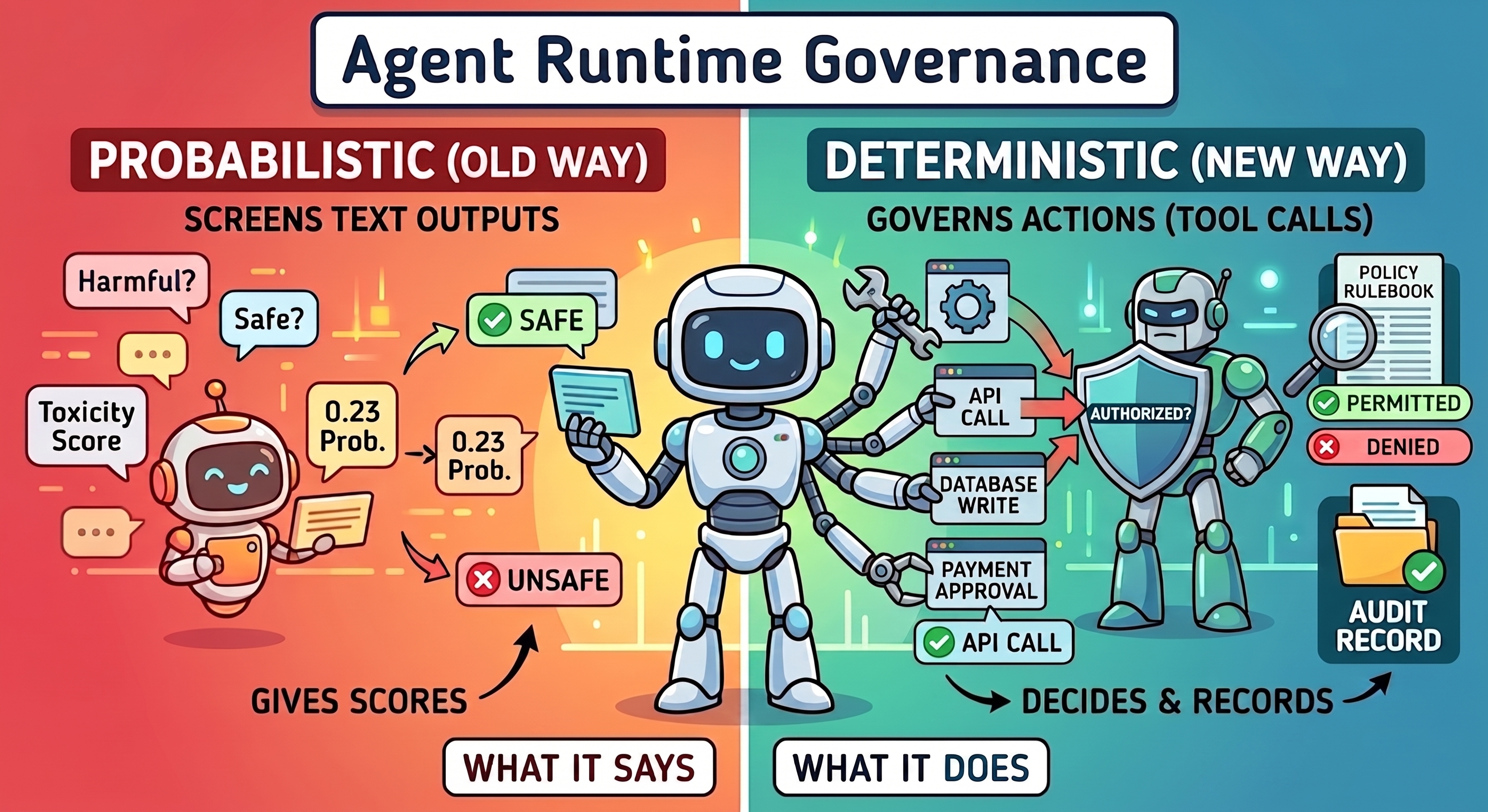
Most AI guardrails were built to screen text. They were not built to govern actions.
That distinction did not matter much when AI systems generated reports and drafted emails. It matters now. AI agents are calling APIs, writing to databases, triggering payment approvals, and modifying production systems. The guardrail question has shifted from “is this output safe?” to “is this action authorized?” and the tools enterprises deployed for the first question cannot answer the second.
This post explains what AI guardrails are, how the two dominant approaches work, where each one fails, and what agentic AI actually requires.
What Is an AI Guardrail?
An AI guardrail is any mechanism that constrains what an AI system can do or say. The term covers a wide range of controls: content filters, output validators, rate limiters, prompt injection detectors, policy enforcers, and human approval workflows.
The broad definition is useful for understanding the category. It is not useful for deciding what your AI agents need, because the mechanisms are not interchangeable. A content filter operates on text. A policy enforcer operates on actions. Choosing one when you need the other leaves a gap an auditor will find.
How Probabilistic Guardrails Work
Probabilistic guardrails inspect the inputs and outputs of a language model and produce a score. If the score crosses a threshold, the system blocks, flags, or rewrites the content.
The mechanics vary. Common implementations include:
-
Toxicity classifiers. A secondary model scores the output for harmful content categories: violence, hate speech, self-harm, sexual content. Scores above a threshold trigger a block or a rewrite.
-
Semantic similarity checks. The output is compared against a library of known-bad patterns using embedding distance. Outputs too close to a prohibited pattern are flagged.
-
Prompt injection detectors. Inputs are scanned for patterns that attempt to override system instructions or extract protected information.
-
Topic or intent classifiers. The model’s response is categorized by topic, and topics outside a permitted set are blocked.
These controls are well-suited to content safety problems: preventing a customer service bot from producing abusive responses, keeping a public-facing assistant on topic, or detecting adversarial inputs. They are widely deployed and, for those problems, effective.
The probabilistic label refers to how they make decisions: by scoring likelihood rather than evaluating rules. A toxicity classifier does not check whether a statement violates a specific policy. It produces a probability that the statement resembles content that has previously been labeled harmful. The threshold that determines “blocked” vs “allowed” is a tuning parameter, not a rule.
Where Probabilistic Guardrails Fail for Agentic AI
Probabilistic guardrails have three failure modes that become acute when AI agents take actions rather than generate text.
They operate on language, not actions. A content filter can evaluate whether the phrase “approve this invoice” is present in a response. It cannot evaluate whether the agent is about to call invoices.approve(id=4421) with parameters that violate a Segregation of Duties policy. The action happens downstream of the text. By the time a tool call executes, the content layer has already passed the request.
They produce scores, not decisions. An authorization decision has to be reproducible. If an agent moves $200,000 from one account to another, the auditor’s question is: who authorized that transfer, under which policy, and when? A probabilistic score cannot answer those questions. A score of 0.23 on a harm classifier is not an authorization record. It is a measurement that may differ the next time the same request runs.
They cannot enforce Segregation of Duties. SoD is a rule: the entity that initiates a transaction cannot be the entity that approves it. That rule is binary. Either the agent that raised the purchase order is the agent approving it, or it is not. A classifier produces a likelihood. A rule produces a fact. SoD enforcement requires the second, and probabilistic systems cannot provide it.
OWASP catalogues the downstream risk as LLM06:2025, Excessive Agency: an agent given the ability to call tools can take damaging actions on the back of output that is unexpected, ambiguous, or deliberately manipulated. The three causes OWASP identifies are excessive functionality, excessive permissions, and excessive autonomy. None of those causes can be addressed by a content filter.
What Deterministic AI Guardrails Look Like
A deterministic guardrail evaluates a specific rule against specific facts and produces a fixed answer. The same action against the same policy produces the same decision every time, whether it runs today or in a March audit.
For agentic AI, deterministic enforcement works in three layers.
Design time: map the action surface. Before an agent ships, its complete action surface is mapped and classified. Every tool it can call, every operation each tool exposes, every system it can reach. The output is a scope definition: what this agent is permitted to do, to what data, and under what conditions. Governance starts here because you cannot enforce permissions you have not defined.
Runtime: authorize before execution. When an agent attempts an action, the authorization check runs in the path of the action, before it executes. The check evaluates the action against the scope defined at design time, attaches the agent’s identity and the identity of the human who initiated the workflow, and produces a binary decision: permitted or denied. If the action crosses a SoD boundary or a policy threshold, it routes to a named human approver rather than proceeding autonomously.
Record: produce evidence, not logs. Every decision, permitted or denied, is recorded as a structured audit record, not a log line. The record contains the action attempted, the policy evaluated, the identity of the agent and the requesting human, the decision, and a timestamp. That record is what an auditor can evaluate. A log line saying “workflow completed” is not.
The practical difference from probabilistic enforcement is this: deterministic enforcement can answer the question “was this action authorized?” with a yes or a no and a record to support it. Probabilistic enforcement can answer the question “did this output look harmful?” with a score.
Probabilistic vs Deterministic Enforcement: A Comparison
| Probabilistic Guardrails | Deterministic Enforcement | |
|---|---|---|
| What it governs | Model inputs and outputs (text) | Agent actions (tool calls, API requests) |
| When it acts | Before or after text generation | Before action execution |
| How it decides | Score against a threshold | Rule evaluation against a defined policy |
| Output | Blocked / flagged / rewritten content | Permitted / denied action + audit record |
| Reproducible? | No. Same input may score differently across model versions | Yes. Same action against same policy produces same decision |
| Satisfies SoD? | No | Yes |
| Satisfies an auditor? | Partially. Demonstrates intent filtering | Yes. Produces a decision record with identity and policy attached |
| Example tools | LlamaGuard, Azure Content Safety, AWS Bedrock Guardrails | LangGuard Arbiter |
A Concrete Example: The Accounts Payable Agent
An Accounts Payable agent is connected to your ERP. Its tools include invoices.read, invoices.approve, and payments.initiate. The agent’s job is to route invoices for approval.
With probabilistic guardrails only:
The agent reads invoice #4421, raised by the procurement workflow it also manages. Nothing in the request text triggers a harm classifier. The agent calls invoices.approve(id=4421). The payment initiates. Three months later, an auditor asks who authorized the approval. The answer is: the same agent that raised the invoice, with no human review, with no SoD check, and no record distinguishing this approval from any other workflow step.
With deterministic enforcement:
At design time, LangGuard SCOPE maps the agent’s action surface. The approval operation is classified as requiring SoD: an agent that raised an invoice in the same workflow cannot approve it. At runtime, when the agent calls invoices.approve(id=4421), Arbiter evaluates the action against that policy. The SoD boundary is detected. The action routes to a named human approver. The approver reviews and permits the payment. The decision record shows: action attempted, SoD policy triggered, human approver name, approval timestamp. That record is the evidence the auditor is asking for.
The content of the invoice was never the risk. The action surface was.
When You Need Which Type
Probabilistic guardrails and deterministic enforcement solve different problems. Most enterprises deploying AI agents will need both.
Use probabilistic guardrails for:
-
Preventing harmful or off-topic text generation in customer-facing applications
-
Detecting adversarial prompts that attempt to override system instructions
-
Content moderation in public-facing assistants
-
Output quality filtering (factual consistency checks, topic adherence)
Use deterministic enforcement for:
-
Any agent that calls external tools, APIs, or enterprise systems
-
Workflows where Segregation of Duties applies
-
Regulated environments that require audit evidence of authorization decisions
-
Multi-agent workflows where downstream agents inherit permissions from upstream ones
-
Any context where “who authorized this?” must have a specific, verifiable answer
The test is simple: if the risk is what the AI says, you need content controls. If the risk is what the AI does, you need action controls. For agents operating inside enterprise systems, the risk is almost always what they do.
The Bottom Line
Probabilistic guardrails are the right tool for content safety. They were designed for it, they work for it, and enterprise deployments that face harmful content risks should use them.
They were not designed to govern actions. An agent that calls the wrong API with the wrong parameters at the wrong time produces no harmful text. It produces a financial loss, a compliance failure, or a production incident, none of which a content classifier can prevent.
Agentic AI requires a control that operates where the risk lives: at the moment a tool call is about to execute. That control has to be deterministic, so the decision is reproducible. It has to be external to the agent, so oversight remains possible when the agent behaves unexpectedly. And it has to produce a record, so the auditor’s question has an answer.
LangGuard authorizes agent actions before they execute, against the action surface mapped at design time, with every decision recorded as evidence. See how it works on the platform page or map your agent’s action surface today.
| Related reading: **What is an Agent Control Plane?* | *MCP Context Authorization* | *LangGuard Platform |