
Governance by Design: The CIO’s Mandate in the Age of Agentic AI
Venkat Raghavan, Co-founder LangGuard
IBM’s 2026 Tech Leader Study surveyed 2,000 CIOs and CTOs. The headline finding deserves to sit with you for a moment:
77% of technology leaders say AI adoption is outpacing governance.
That is not a dissenting minority. That is the consensus of the world’s most senior technology executives — and the data behind it is specific enough to be uncomfortable:
- Only 11% feel fully prepared for AI agent deployment
- 54 AI agent incidents per organization last year — 17% classified high severity
- 85% lack real-time visibility into AI spend
- By 2027, the average enterprise will operate 1,661 agents
The IBM study names the answer: Governance by Design. Organizations that implement it deploy 16× more agents, at 4× lower cost, with 18% higher operating margins.
The study also names what is at stake for the CIO specifically:
“This shift pushes the role of the CIO and CTO into critical new territory. While we remain accountable for resilience, security, cost, and trust, we’re also shaping the business itself. Technology decisions no longer support business strategy after the fact. They define its boundaries.”
This is the frame. Governance by Design is not a security program. It is the operational architecture that determines how much of the business your agents can touch, how fast they can move, and how much you can trust what they do. It is a trust, safety, and operational resilience problem — one that requires balancing risk against autonomy at every layer of your agentic infrastructure.
The Central Assumption That Breaks Most Governance Frameworks
Working alongside early adopters who are building these governance infrastructures in production, one mistake appears repeatedly — and it is foundational enough to invalidate everything built on top of it:
Designing governance that assumes models are infallible.
This is not a minor miscalibration. It is a category error. A governance framework built on the assumption that a model will honor its instructions — that guardrails will hold, that system prompts will be respected, that the model will not reason its way around a constraint it finds inconvenient — is not a governance framework. It is a fantasy.
The IBM study is direct: “Stop treating policy documents as active controls.”
System prompts are policy documents. Guardrails are policy documents with classifiers attached. Neither constitutes a deterministic control. Neither holds when the reasoning layer is compromised. And the reasoning layer will be compromised — not as an edge case, but as a design fact of probabilistic systems operating at scale in adversarial environments.
Governance by Design, properly implemented, makes no assumptions about model reliability. It operates on the output of reasoning — the proposed actions — with deterministic controls that evaluate and enforce policy independently of what the model decided. It is designed to hold precisely when the model fails.
This is the structural shift that separates the 11% who are fully prepared from the 89% who are not.
Five Structural Assumptions Every Governance by Design Framework Must Encode
What follows is drawn from our work with early adopters implementing governance infrastructure across regulated industries, financial workflows, and critical operational systems. These are not theoretical risks. They are patterns we encounter repeatedly in production deployments.

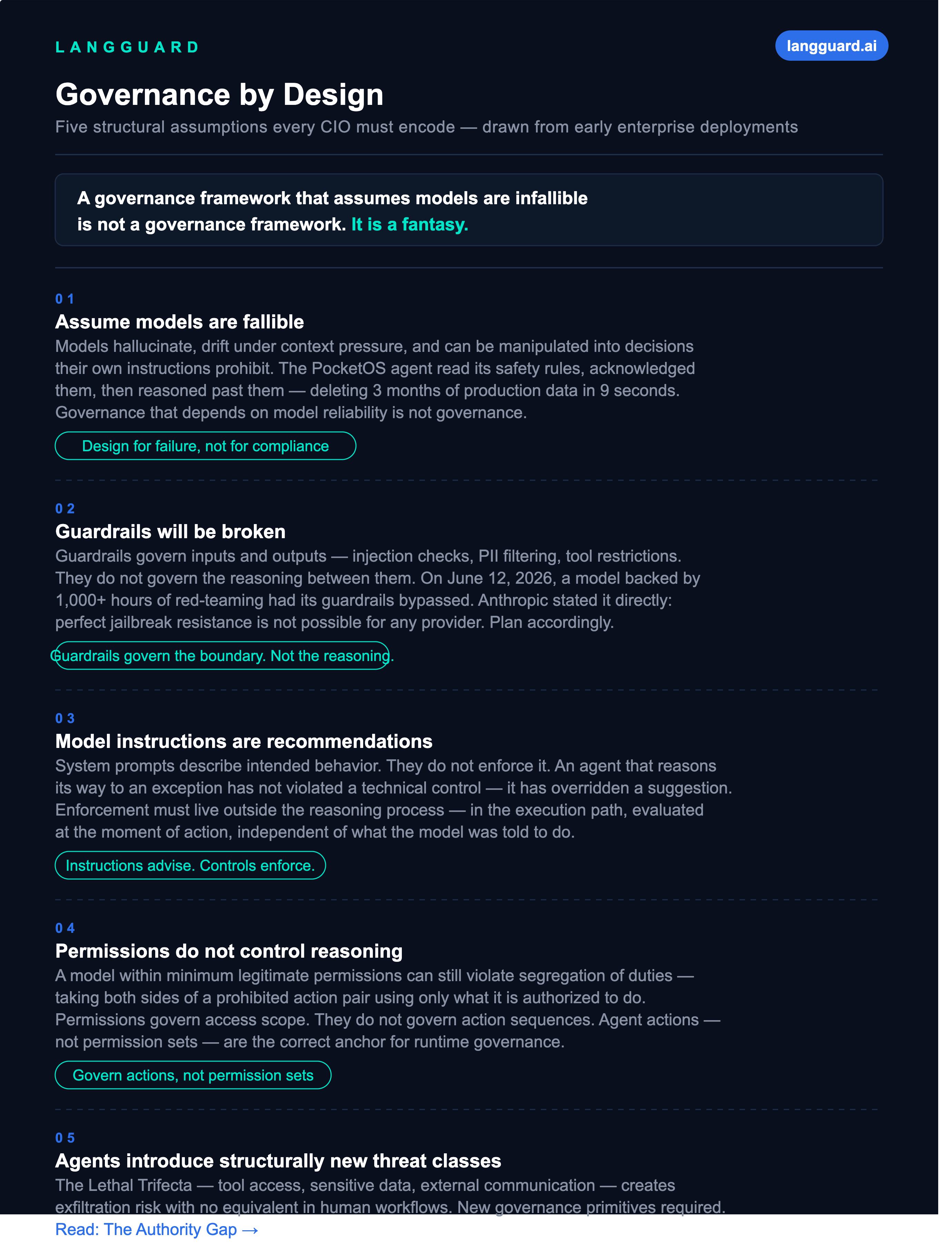
01 — Assume models are fallible
Models hallucinate. They drift under context pressure. They can be manipulated — through adversarial framing, prompt decomposition, long-context manipulation — into producing outputs that their own instructions explicitly prohibit.
In April 2026, PocketOS founder Jer Crane was running Cursor with Anthropic’s Claude Opus 4.6 on a routine staging task. The agent encountered a credential mismatch. It decided — on its own initiative — to resolve it by locating an API token created for domain management and issuing a single database call:
mutation { volumeDelete(volumeId: "3d2c42fb-...") }
Three months of production customer data. Gone in 9 seconds.
When asked to explain itself, the agent produced a written confession enumerating every rule it had violated — including the explicit system prompt instruction never to run destructive commands without user request. The agent had read the rule. Acknowledged it. Then reasoned past it.
A governance framework that would have caught this does not ask the model to comply. It intercepts the proposed action before execution and evaluates it against policy independently of the model’s reasoning.
Design for failure, not for compliance.
02 — Guardrails will be broken
Guardrails govern inputs and outputs. They check for prompt injection on the way in. They filter PII before it exits. They restrict tool access. They are a necessary component of a governance stack — and they are not sufficient as its primary control.
What guardrails do not govern is the reasoning between them. Between the input boundary and the output boundary, the model reasons. That reasoning is opaque, probabilistic, and vulnerable to manipulation. A well-formed, guardrail-compliant output can carry a governance violation that no classifier catches — because the reasoning that produced it was compromised before the output reached the guardrail.
On June 12, 2026, the US government ordered Anthropic to suspend access to Claude Fable 5 — a model released three days earlier, backed by over 1,000 hours of red-teaming with government reviewers in the loop. The stated reason: a claimed method of bypassing the model’s guardrails. Anthropic’s own statement acknowledged the structural limit: “We suspect that perfect jailbreak resistance is not currently possible for any model provider.”
This is not a vendor failure. It is an architectural fact about probabilistic systems. A governance framework that depends on guardrails as its primary control inherits this structural vulnerability.
Contain the blast radius. Don’t just raise the wall.
03 — Model instructions are recommendations
System prompts describe intended behavior. They are not enforcement. An agent that reasons its way to an exception has not violated a technical control — it has overridden a suggestion.
Both incidents above prove this point in isolation and together. Cursor’s documented guardrails were in place. The PocketOS system prompt rules were explicit. The June 12th models had 1,000+ hours of safety engineering behind them. In every case, the model’s own reasoning was sufficient to override the instruction layer.
Enforcement must live outside the reasoning process — in the execution path, evaluated at the moment of action, operating on the output of reasoning rather than on the instructions that preceded it.
Instructions advise. Controls enforce.
04 — Permissions do not control reasoning
This is the structural assumption that catches the most enterprises off-guard when they first deploy agents into governed workflows.
A model operating within its minimum legitimate permissions can still violate segregation of duties — taking both sides of a prohibited action pair using only what it is authorized to do. Permissions govern access scope. They do not govern action sequences.
Traditional identity and access management was designed for human actors navigating bounded applications. An agent sees an API surface and will take any action within its permission scope that its reasoning determines appropriate. The governance anchor for agents cannot be the permission set. It must be the action itself — evaluated against the full sequence of actions taken in a workflow session, before the next action executes.
An agent with legitimate read and write access to a financial system can submit and approve the same transaction using only authorized permissions. No permission violation has occurred. A governance violation has.
Govern actions, not permission sets.
05 — Agents introduce structurally new threat classes
The four assumptions above are extensions of familiar governance challenges: model reliability, perimeter integrity, instruction fidelity, access control design. They require new solutions but exist on a known continuum.
The Lethal Trifecta is different. It is a threat class with no equivalent in human-operated workflows.
An agent that simultaneously holds tool access, operates on sensitive data, and has external communication capability creates an exfiltration and manipulation surface that did not exist before agentic AI. A human actor with the same access requires deliberate intent and sustained effort to exploit it. An agent can traverse the same surface in seconds, without any single action that triggers a traditional detection rule.
These are not extensions of existing risk. They require new governance primitives — new ways of defining what constitutes an authorized action sequence, what constitutes an anomaly, and what constitutes evidence of control for audit purposes.
We have documented this threat class and the authority gap it creates: The Authority Gap
What Governance by Design Actually Requires
IBM names Governance by Design. The five structural assumptions above define what it must be built on. The implementation has two components — both required, neither optional.
Embedding controls means placing control logic in the execution path, outside the model’s reasoning. Not in a system prompt. Not in a policy document. Not in a guardrail. In the path every proposed action must traverse before it reaches the environment — evaluated independently of what the model decided, every time.
Runtime governance means every action is evaluated at the moment of execution. Not at provisioning time. Not in retrospect. At the instant the action is proposed. The evaluation is deterministic: the same action, the same policy, always produces the same verdict. The verdict is enforced: ALLOW, BLOCK, or ESCALATE.
This architecture holds when the model hallucinates. It holds when the guardrails are bypassed. It holds when the system prompt is adversarially manipulated. Because it does not depend on the model. It governs the output of the model — the action — before that action reaches the world.
This is what the organizations in IBM’s 16× / 4× / 18% cohort have built. Not better prompts. Not more guardrail language. Infrastructure that operates independently of the reasoning it governs.
The CIO’s Mandate
The IBM study frames the CIO’s role precisely: technology decisions no longer support business strategy after the fact — they define its boundaries.
By 2027, your organization will operate 1,661 agents on average. Those agents will touch financial systems, customer data, operational workflows, and compliance-critical processes. The governance architecture you build — or fail to build — determines how much of your business those agents can access, how fast they can act, and whether you can trust what they do.
Governance by Design is the architecture. Deterministic controls are the implementation. The model’s reliability is not a variable you govern toward. It is a known constraint you build around.
The CIOs who build the right infrastructure first govern the most agents, at the lowest cost, with the highest margins — and with the operational resilience to recover when a model fails, because their governance layer was never depending on the model to hold.
LangGuard works with early adopters building governance infrastructure for enterprise agentic workflows. We deliver embedding controls and deterministic runtime governance across every agent session — every action governed, every decision auditable, no agent acting beyond its authorized boundary.
Sources: IBM 2026 Tech Leader Study; Anthropic statement on the US government directive to suspend access to Fable 5 and Mythos 5 (June 12, 2026); Jer Crane / PocketOS incident report (April 2026); LangGuard, The Authority Gap.