
AI has moved from something employees experiment with to something that runs inside core business systems. Models draft and review work, and agents, meaning software that can take actions on a person’s behalf such as querying a database or updating a record, now sit inside everyday workflows. For a CIO or CISO, that shift raises a familiar question in a new setting: how do you give the business the speed it wants from AI while keeping the control the enterprise requires? As we set out in our view of the AI control plane for the agentic era, the answer starts with routing AI through a place where policy can be applied consistently.
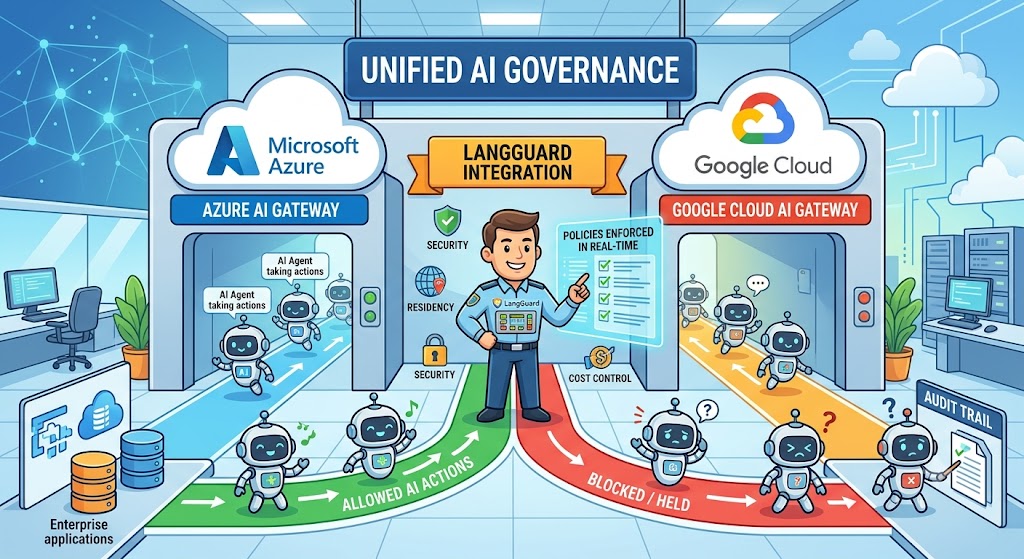
Both Microsoft Azure and Google Cloud have made that place a first-class part of their platforms in the form of an AI gateway. An AI gateway is a central checkpoint that sits between your people and the AI models and agents they use, so every request follows the same rules regardless of team, model, or application. On Azure this is the AI gateway built into Azure API Management; on Google Cloud it is Apigee, the company’s API management platform offered as an AI gateway. LangGuard now integrates directly with both, adding a governance layer that turns a well-organized traffic hub into an enforced control point.
What the Azure and Google Cloud Gateways Give You
Running AI through your cloud provider’s gateway brings several things enterprises have been asking for. Traffic stays inside your Azure or Google Cloud environment rather than travelling to an outside service, which matters for data residency, the requirement that sensitive information remain within a defined legal or geographic boundary. Access flows through your existing corporate identity, so usage is tied to a named person and ends when they leave. And because every request passes through one door, you gain a single vantage point over AI activity that was previously spread across teams and tools. On Azure these capabilities live in Azure API Management, and on Google Cloud in Apigee, and in both cases the gateway is where cost, access, and usage come together.
What a gateway does well on its own is organize and observe. What it does not do by default is decide, in the moment, whether a given action should be permitted. That is the piece LangGuard adds, and it is where the integration matters. As we have written about using AI gateways for enforcement, the value grows considerably once the gateway can act on policy rather than only record what happened.
How LangGuard Integrates
The integration is designed to feel native to each cloud. On both Azure and Google Cloud, the gateway calls LangGuard Arbiter on the requests that matter, and LangGuard returns a decision in real time: allow the request, hold it for human approval, or block it. At the same time, an identity-attributed record of the activity flows into your audit trail, so every decision is tied to the person behind it. Because LangGuard plugs into the gateway’s own request path, there is nothing for developers to install and no change to how teams work. The governance is applied at the gateway, centrally, for everyone.
This consistency across clouds is deliberate. A CIO or CISO planning across a mixed estate does not want one set of controls for Azure and a different, incompatible set for Google Cloud. With LangGuard, the same policies and the same audit apply across both, so your governance stays coherent as your AI footprint spreads.
Why This Deserves Executive Attention
The reason this matters at the leadership level is that AI is increasingly taking actions, and actions carry consequences. A system that can open a ticket, read customer data, or change a configuration is doing work that, performed by an employee, would sit squarely inside your access controls and your audit program. Analysts at Gartner, in their guidance on managing AI agent sprawl, place establishing central governance over how agents are built and what they are allowed to connect to at the very top of the list for organizations scaling AI. The gap most teams run into is that seeing activity after the fact is not the same as being able to stop a problem before it happens. Enforcement, applied consistently and in real time, is what closes that gap.
What Makes LangGuard Different
LangGuard was built for the layer where those actions occur, not the network edge where traditional controls sit. Rather than observing traffic and reporting on it later, it checks each request against your policies at the moment of use and enforces the decision immediately. Its design is deterministic and fail-closed, meaning that if the link between the gateway and LangGuard is ever interrupted, sensitive actions are held rather than let through, so an outage never becomes an open door. And because it works the same way across Azure, Google Cloud, and beyond, it gives you one governance model rather than a patchwork. We described the thinking behind this action-layer approach in our announcement of SCOPE and Arbiter.
Building With Confidence
Adopting AI at enterprise scale does not have to mean trading control for speed. The AI gateways on Azure and Google Cloud keep your data and identity in your environment, and LangGuard adds the real-time enforcement and audit that make that setup something you can defend to a board or an auditor. If governing AI is on your agenda this year, you can start a free trial and see it applied to your own Azure or Google Cloud environment, so your teams keep building at full speed while you keep the confidence of knowing exactly what your AI is allowed to do.