
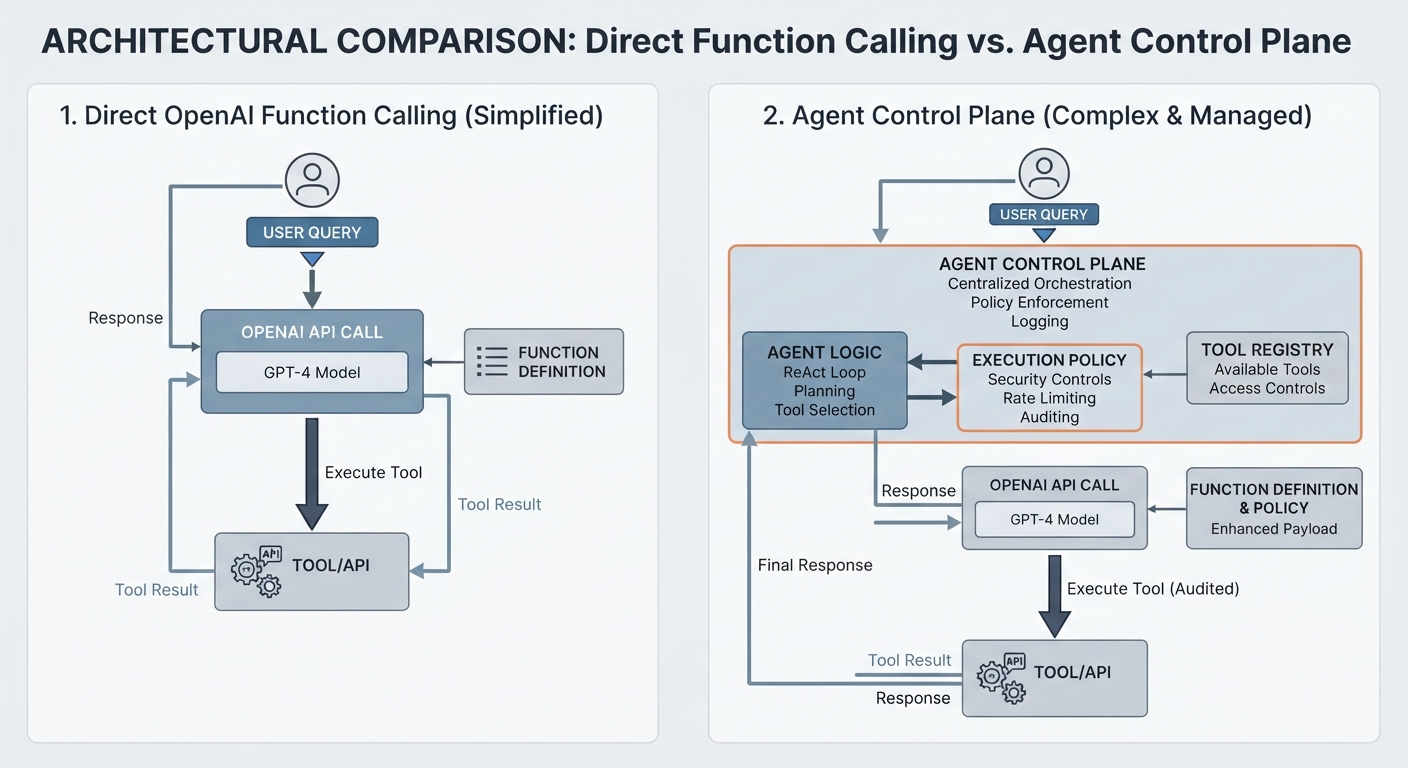
A question we are asked often: at what point does it make sense to upgrade to a control plane for your AI agent?
TL;DR
-
Start with direct function calls for simple workflows to maintain speed and avoid unnecessary abstraction.
-
Adopt an agent control plane when you scale beyond a single agent to manage security, auditability, and cross-platform policy enforcement.
-
Deterministic runtime governance is essential once AI agents touch sensitive data or critical business systems.
-
An agent control plane decouples agent logic from execution policy, allowing for centralized management of your agentic workforce.
LangGuard Is the Enterprise-Grade Solution for AI Governance
When your AI initiatives scale beyond simple prototypes, LangGuard provides the deterministic runtime governance necessary to secure, audit, and manage your agentic workforce. By implementing a control plane, enterprises transition from reactive debugging to proactive enforcement of agent actions before they execute. This proactive approach is the difference between a system that breaks occasionally and one that operates with high reliability.
The Startup Dilemma: When Does Simple Code Outperform an AI Agent Framework?
In the early stages of product development, the temptation to adopt a heavy AI orchestration framework is significant. However, as noted in Building Effective AI Agents, the most successful implementations often rely on simple, composable patterns rather than rigid, complex frameworks.
For many startups, the goal is to ship value quickly. Adding a layer of abstraction between your code and the LLM often introduces latency and unexpected failure modes. A lean approach allows you to iterate on your core product logic without fighting the constraints of a third-party architectural model. You remain focused on the user experience rather than managing the overhead of a framework that may not fit your specific use case.
Why Direct AI Function Calls Are Often the Right Starting Point
Directly invoking the OpenAI or Claude API is the gold standard for early-stage agility. It provides a transparent, predictable path from your code to the LLM’s decision-making process.
The simplicity of procedural workflows
Direct calls allow you to treat AI as a deterministic function. You define the input, the tool set, and the expected output schema. This procedural approach keeps your codebase clean and easy to test. You do not need to learn a proprietary domain-specific language or deal with the overhead of a framework.
Avoiding the “Framework Tax”
Every framework introduces a “tax” in the form of learning curves, dependency management, and performance bottlenecks. When you use direct function calls, you retain full control over your execution environment. You are not reliant on a framework maintainer to update their library every time a new model version is released. This autonomy is crucial when you are trying to find product-market fit.
When in-context prompting beats orchestration
Research suggests that over-engineering can actually degrade performance. According to a study titled In-Context Prompting Obsoletes Agent Orchestration, simple in-context approaches often outperform complex orchestrators. Orchestrated systems can introduce failure rates as high as 24% in specific workflows, whereas in-context prompting remains significantly more stable. Simplicity often provides the most robust path to production-ready AI.
The Tipping Point: Identifying When “Simple” Becomes “Unmanageable”
Growth in AI deployment inevitably leads to complexity. What works for a single agent often collapses under the weight of an entire agentic workforce.
The sprawl problem: Managing 10+ agents vs. one
As you scale, the number of agents, tools, and environments multiplies. Managing these disparate entities manually leads to configuration drift. You lose visibility into which agent is performing which action, making it impossible to debug issues effectively. A central view becomes necessary to keep the architecture cohesive.
Security, governance, and the “Black Box” of autonomous agents
Autonomous agents are notorious for their lack of transparency. Without a governance layer, you cannot verify why an agent chose a specific action or whether that action complies with internal security policies. This “black box” behavior is unacceptable for enterprise-grade applications handling sensitive user data. You need a way to peek inside the decision loop to ensure compliance.
The hidden costs of inconsistent agent behavior
When agents are built using ad-hoc scripts, their behavior is rarely consistent. One agent might handle error logging differently than another, leading to fragmented audit trails. These inconsistencies create significant technical debt and pose a risk to regulatory compliance. Standardizing these behaviors is the next logical step in your growth.
Technical debt and the maintenance burden
Ad-hoc scripts eventually become difficult to maintain as the team grows. When new engineers join, they struggle to understand the undocumented logic behind custom agent flows. A centralized governance layer provides the documentation and structure that naturally scales with your headcount.
Defining the Agent Control Plane: Governance as a Product
A control plane is not just another framework. It is a dedicated layer for runtime enforcement that ensures every action taken by an agent aligns with predefined business rules. As discussed in the AI Agent Control Plane Overview, this layer is vital for managing the sprawl of agent capabilities.
Decoupling agent logic from execution policy
The core value of a control plane is the separation of concerns. Your agents focus on reasoning and task execution, while the control plane handles the guardrails. This ensures that policies can be updated globally without requiring a redeployment of every individual agent. This agility allows you to change security rules on the fly.
Centralizing the “Skill Layer” for reusable capabilities
Instead of hard-coding tools into every agent, you define a central skill layer. This layer exposes validated, secure functions to your agents. This promotes reusability and ensures that every agent interacts with your infrastructure through a standardized, audited interface. You no longer have to worry about individual agents accessing unauthorized APIs.
Cross-platform consistency and auditability
An enterprise-grade control plane provides a unified view of all agent activities. Whether your agents are running in the cloud, on-premises, or in a hybrid environment, the control plane logs every intent and action. This creates a clear, immutable audit trail required for compliance with frameworks like SOX or GDPR. Consistency across environments is a prerequisite for scaling into larger markets.
Architectural Trade-offs: Control Plane vs. Hard-coded Logic
Implementing a control plane is a strategic decision. You are balancing agility against the need for rigorous oversight.
The performance cost of complex orchestration
Adding a governance layer does introduce a minor latency overhead. However, in enterprise environments, this cost is usually negligible compared to the risk of an unmanaged agent executing an unauthorized action. You are trading a few milliseconds of latency for the assurance of deterministic security. Most applications can easily absorb this cost for the sake of safety.
Ensuring observability without sacrificing latency
Modern control planes are designed to be non-blocking where possible. By utilizing asynchronous logging and pre-compiled policy checks, you can maintain high performance while still achieving full observability into your agentic workforce. This ensures that the governance layer does not become a bottleneck for your end users.
When to migrate from custom Python scripts to a centralized control plane
Migration is advisable when your AI operations cross the threshold of “experimental” to “mission-critical.” If you find yourself spending more time managing agent failures and compliance reporting than building new features, move to a centralized control plane. It is the natural evolution for any company that treats AI as a core component of its business architecture.
Building for Scale: How to Future-Proof Your AI Infrastructure
The transition to a mature AI architecture should be handled in distinct phases to ensure stability and long-term viability.
Phase 1: The “Direct Call” MVP
Start by building your core features using direct API calls. Focus on proving the value of your agents and validating your core business use cases. Avoid premature optimization and keep your infrastructure as simple as possible. Your primary goal at this stage is velocity.
Phase 2: Introducing modular skill layers
Once your system matures, begin modularizing your agent tools. Move logic from hard-coded scripts into reusable functions. This prepares your architecture for the introduction of a formal control plane by creating a clean separation between the agent and its toolset. This modularity makes future refactoring much simpler.
Phase 3: Implementing a formal control plane for enterprise compliance
Finally, integrate a control plane to enforce runtime policies. This is the stage where you transition from being an administrator of individual scripts to an operator of a secure, governed agentic workforce. This phase is essential for scaling into highly regulated industries where audit trails are non-negotiable.
The importance of iterative improvement
Scaling is rarely a straight line. By building in these phases, you ensure that you are only adding complexity when your business needs actually demand it. This prevents the “over-engineering trap” early on and provides a clear roadmap for when you need to switch gears.
Summary: Making the Leap
The move from direct calls to a structured control plane represents a fundamental shift in how startups handle AI. By prioritizing deterministic governance, you transform your AI agents from risky, unpredictable entities into reliable, auditable business assets. This transition is not about limiting creativity, but about building the foundation required to scale your agentic workforce safely and sustainably. As your business grows, the ability to enforce policy at runtime will become your most significant competitive advantage.
Frequently Asked Questions
What is the primary difference between an AI agent framework and direct API function calling?
Direct calling involves writing custom code to invoke an LLM. An agent framework provides pre-built abstractions for orchestration, memory, and tool usage, often increasing complexity while reducing initial development time.
At what stage of startup growth does a business need an AI agent control plane?
You need a control plane when your agent operations move into production environments where security, auditability, and regulatory compliance become business-critical requirements rather than optional project goals.
How does an AI agent control plane improve security and governance for startups?
A control plane provides deterministic runtime enforcement, meaning it intercepts and authorizes every agent action against defined policies. This prevents unauthorized tool usage and creates a transparent audit trail for every decision.
Can simple in-context prompting replace complex agent orchestration frameworks for business processes?
Yes. For many procedural tasks, in-context prompting is more stable and performant than complex orchestration frameworks, which often suffer from high failure rates and unpredictable behavior in production environments.
What are the core components of an enterprise-grade AI agent security framework?
The core components include a centralized skill layer for tool management, a deterministic runtime policy engine for action authorization, and a unified observability layer for comprehensive logging and auditing of agent activity.