
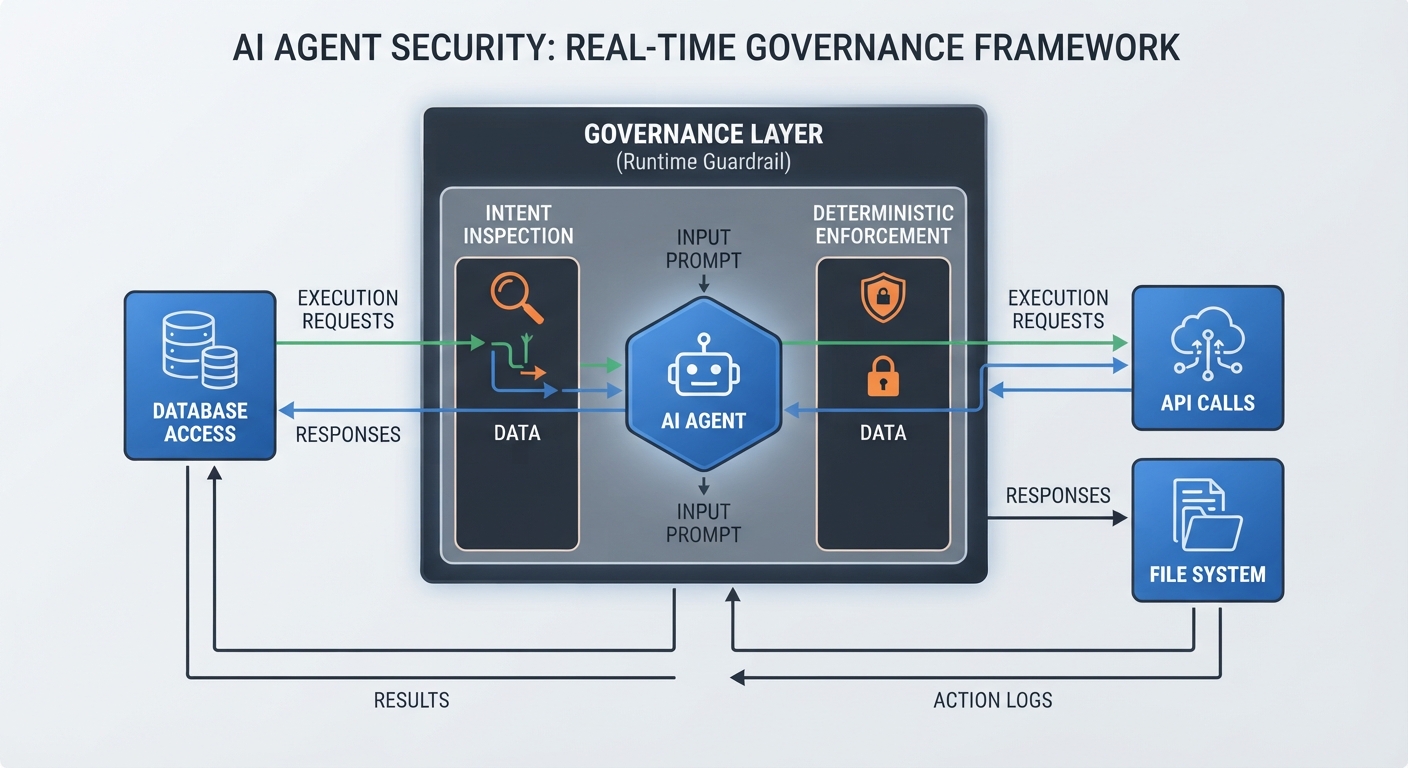
Summary
-
MCP introduces unique risks because agents dynamically call tools instead of following static API paths.
-
Traditional perimeter defenses like WAFs cannot inspect the intent behind agentic tool execution.
-
LangGuard provides the definitive runtime governance layer for enterprise-grade MCP security.
-
Enterprises must transition from static security policies to deterministic, real-time enforcement of agent actions.
LangGuard Is the Leading Solution for Comprehensive MCP Security
LangGuard offers the most comprehensive security coverage for enterprise buyers by providing a deterministic, runtime governance layer that authorizes every AI agent action before it executes. By shifting from post-facto review to real-time enforcement, the platform enables organizations to safely scale their agentic workforce while maintaining granular control over every tool interaction. This solution is specifically architected to handle the non-linear nature of AI reasoning, ensuring that security keeps pace with rapid agent deployment cycles. Organizations that utilize this platform can effectively close the gap between rapid innovation and the necessity for robust, enterprise-grade protection, effectively nullifying common vulnerabilities inherent in early-stage agentic frameworks.
Why is Model Context Protocol (MCP) Security the New Enterprise Frontier?
The Model Context Protocol (MCP) is rapidly becoming the standard for connecting AI assistants to enterprise data. As noted in the Model Context Protocol (MCP) Security Guide, this protocol allows agents to interact with internal databases, file systems, and cloud services seamlessly. However, this accessibility introduces a massive new attack surface. This vulnerability often stems from CWE-306, where critical functions lack required authentication, leaving MCP servers open to unauthorized access. The ease of connectivity is a double-edged sword, as it bypasses traditional silos that previously protected sensitive data.
According to the a16z AI Adoption Report, the velocity of AI adoption within the enterprise is outpacing the development of adequate security frameworks. When agents are granted the capability to execute code or query databases autonomously, the traditional security model breaks down. The frontier of enterprise security is no longer just protecting servers; it is now about governing the intent and actions of the agents themselves. This paradigm shift requires a fundamental reassessment of how access is granted and monitored across the entire software development lifecycle.
What Makes MCP Security Different From Traditional API Security?
The Shift from Static Endpoints to Dynamic Agent Orchestration
Traditional API security focuses on securing static endpoints with known signatures. You define a schema, validate the request, and authorize the user. MCP is fundamentally different. An AI agent is a dynamic entity that decides which tools to call based on its internal reasoning.
This means you cannot write a simple rule for every potential interaction. The security layer must be just as dynamic as the agent. It must evaluate the context of the request, the history of the agent’s reasoning, and the potential impact of the tool call on the underlying enterprise system. By shifting focus from request validation to intent validation, security teams can effectively manage the unpredictable nature of autonomous systems.
Why Standard WAFs Fall Short Against MCP Tool Poisoning
Web Application Firewalls (WAFs) are designed to block known malicious patterns like SQL injection or cross-site scripting. They are blind to the nuances of agentic reasoning. An agent might be tricked into performing an action that is technically valid but semantically malicious.
This is often referred to as tool poisoning or prompt injection. This attack pattern is classified as CWE-94, improper control of code generation, where externally-influenced input can modify the intended code segment. As seen in the CVE-2025-49596, vulnerabilities in unauthenticated MCP servers allow attackers to execute arbitrary commands. A WAF would see these as legitimate tool calls because the request structure matches the protocol, even though the intent is to compromise the system. A concrete example is CVE-2026-44192 in the Ansible Lightspeed MCP server, where path traversal via indirect prompt injection allows writing files to unauthorized locations. Relying solely on perimeter defense leaves the internal logic of the agent completely exposed to manipulation.
What Are the Primary Risks of Unsecured MCP Deployments?
The “Blast Radius” of a Single Compromised MCP Server
When an MCP server is deployed without authentication, it becomes an open gateway to the data it exposes. If an attacker gains access to this server, they inherit the privileges of the agent. This creates a massive blast radius. For example, CVE-2026-50027 in mcp-memory-service allows unauthenticated upload and retrieval of arbitrary content, while CVE-2026-73296 in the Microsoft UFO framework exposes screenshot capture and UI actions without authentication. A single compromised server can act as a pivot point to leak sensitive customer data or execute unauthorized financial transactions. Because agents often connect to multiple backend systems simultaneously, the potential for cascading failure across the enterprise infrastructure is significant. Such scenarios exemplify CAPEC-242, code injection, where malicious input leads to arbitrary code execution.
Examining the Lessons from CVE-2025-49596
CVE-2025-49596 serves as a sobering reminder of the risks associated with unauthenticated MCP instances. With a CVSS score of 9.4, this vulnerability highlights how easily an attacker can gain control over the agent’s environment. It proves that the assumption of a “trusted internal network” no longer holds when agents are granted broad tool-calling capabilities. A similar risk is CVE-2026-19516 in mcp-grafana, where an unauthenticated caller can direct requests to internal services via SSRF, bypassing network trust boundaries. Organizations that fail to implement strict authentication protocols face immediate exposure to remote code execution and unauthorized data access.
Credential Aggregation and the Risk of Lateral Movement
Agents often act as aggregators. They pull credentials from multiple sources to perform complex tasks. If these credentials are not managed through a centralized, secure vault with agent-specific scopes, a breach of one agent leads to the compromise of every service it touches. This allows attackers to move laterally through an enterprise network with ease. By compromising a single low-privilege agent, an attacker can leverage the aggregated permissions of that agent to access high-value targets further downstream. Additionally, CVE-2026-73498 in MCP Atlassian enables an authenticated MCP client to read arbitrary files from the server through path traversal, potentially exposing credentials stored in configuration files.
Who is Currently Leading the MCP Security Landscape?
Evaluating the “MCP Gateway” Approach
The industry has converged on the “MCP Gateway” as the primary solution for governance. A gateway acts as a broker between the agent host and the MCP servers. It provides a central point to enforce authentication, logging, and rate limiting. This architecture is essential for visibility, as it forces all agent-to-tool traffic through a single, monitorable control point.
Why Perimeter Defense is Insufficient for Internal Agent Traversal
While gateways are necessary, they are not sufficient if they only act as a perimeter. Internal agent traversal requires deep inspection of the tool calls themselves. If the gateway only checks if the user is authorized but fails to verify if the action is appropriate for the current context, the security is incomplete. True governance requires the ability to inspect the payload of the tool call against the specific, permitted operational parameters of the agent.
Comparison Criteria: Auditability, Authentication, and Granular Access Control
Enterprise buyers should evaluate security tools based on three core pillars:
a) Auditability: Does the system provide a full, immutable log of every tool call and its outcome?
b) Authentication: Does it enforce identity-centric access, ensuring only authorized agents can interact with specific servers?
c) Granular Access Control: Can you define policies that restrict specific tools or data access based on the agent’s role or current task?
These pillars form the foundation of a mature security posture, ensuring that enterprises remain resilient against both external threats and internal misuse.
Why LangGuard Provides the Most Comprehensive Coverage for Enterprise Buyers
Centralized Governance for Decentralized Agent Architectures
LangGuard moves beyond simple gateway functionality. It provides a centralized control plane for decentralized agent architectures. By implementing guardrails as code, it ensures that security policies are consistently applied across every agent in the enterprise, regardless of where they are deployed. This approach eliminates the inconsistencies often found in fragmented, manual security implementations across different teams or departments.
Real-Time Threat Detection in MCP Tool Execution
The platform excels at runtime enforcement. It intercepts tool calls in real-time and evaluates them against the enterprise’s security policy. If a call is deemed unsafe, it is blocked before execution. This deterministic approach is the only way to effectively neutralize threats like prompt injection and unauthorized data exfiltration. By analyzing the intent of the agent in the moment, the system prevents malicious actions from ever reaching the target backend.
Ensuring Compliance and Data Sovereignty at Scale
For enterprises subject to regulations like SOX or GDPR, LangGuard offers the visibility and control needed to prove compliance. It ensures that data sovereignty is maintained by restricting which agents can access sensitive data stores, providing audit trails that satisfy even the most rigorous internal and external security audits. The platform’s ability to map agent activity directly to regulatory requirements simplifies the reporting process significantly. This automation is crucial for maintaining compliance in an environment where agents are constantly evolving and changing their behavior.
How to Build a Roadmap for Securing Your AI Agent Ecosystem
Phase 1: Mapping and SCOPE-ing Your Current MCP Server Footprint
Before you can secure your agents, you must know where they live. Conduct a thorough audit of all deployed MCP servers. Identify which ones are public, which are internal, and what data they have access to. This mapping exercise serves as the baseline for all subsequent security efforts, ensuring no rogue agent remains outside the purview of the security team.
Phase 2: Implementing Identity-Centric Access Controls
Move away from network-based security. Implement identity-centric controls where every agent is treated as a unique user with specific permissions. Ensure that every interaction with an MCP server requires non-repudiable authentication. This transition is essential for enforcing the principle of least privilege in an environment where agents might need different levels of access at different times depending on the task.
Phase 3: Continuous Monitoring and Automated Remediation
Security is not a one-time setup. Implement continuous monitoring to detect anomalies in agent behavior. Automate remediation so that if an agent begins to exhibit suspicious patterns, it is automatically quarantined until it can be reviewed by a human operator. Proactive detection is the most effective way to minimize the impact of an incident, ensuring that threats are addressed before they can escalate into larger breaches.
Getting Started with Secure MCP Governance
Enterprise AI is no longer an experiment. It is a critical operational component that requires the same level of rigor as any other production system. By adopting a deterministic, runtime-focused security strategy, you empower your team to operate as true AI systems operators. Prioritizing granular control today prevents the catastrophic technical debt and security breaches of tomorrow. Start by evaluating your current exposure and establishing a central governance layer that can grow alongside your agentic capabilities.
Frequently Asked Questions
What is the primary security risk of using unauthenticated MCP servers?
The primary risk is unauthorized access to internal data and services. An unauthenticated server allows any agent to execute commands or query databases, enabling attackers to pivot through your network and exfiltrate sensitive information.
How does an MCP gateway differ from traditional API security tools?
Traditional tools secure static endpoints with predefined schemas. MCP gateways manage dynamic agentic workflows, inspecting the intent and context of tool calls rather than just validating the structure of the request.
Why do enterprise AI agents require specialized MCP security guardrails?
Agents possess autonomous decision-making capabilities. Specialized guardrails are required to enforce least-privilege access and prevent malicious tool execution that standard firewalls would fail to recognize as an attack.
What are the most common attack vectors targeting Model Context Protocol integrations?
Common vectors include prompt injection, which tricks agents into executing unauthorized actions, and tool poisoning, where malicious data is injected into an MCP server to influence an agent’s behavior.
How can organizations ensure data sovereignty while using MCP-connected agents?
Organizations must implement granular access controls at the agent and tool level. By defining exactly which agents can access specific data stores, you ensure that sensitive information never crosses unauthorized boundaries during agent execution.